Key Takeaways
- PFAS are highly persistent: They do not break down naturally and can remain in the environment for hundreds of years.
- Widespread exposure is already happening: PFAS are found in water, soil, food, and everyday consumer products, meaning most people have measurable levels in their bodies.
- They pose serious health risks: Linked to cancer, immune system disruption, fertility issues, and developmental effects.
- The problem is global and long-term: Thousands of contaminated sites exist across Europe, and even stopping use today would not remove existing pollution.
What Are PFAS (Forever Chemicals)?
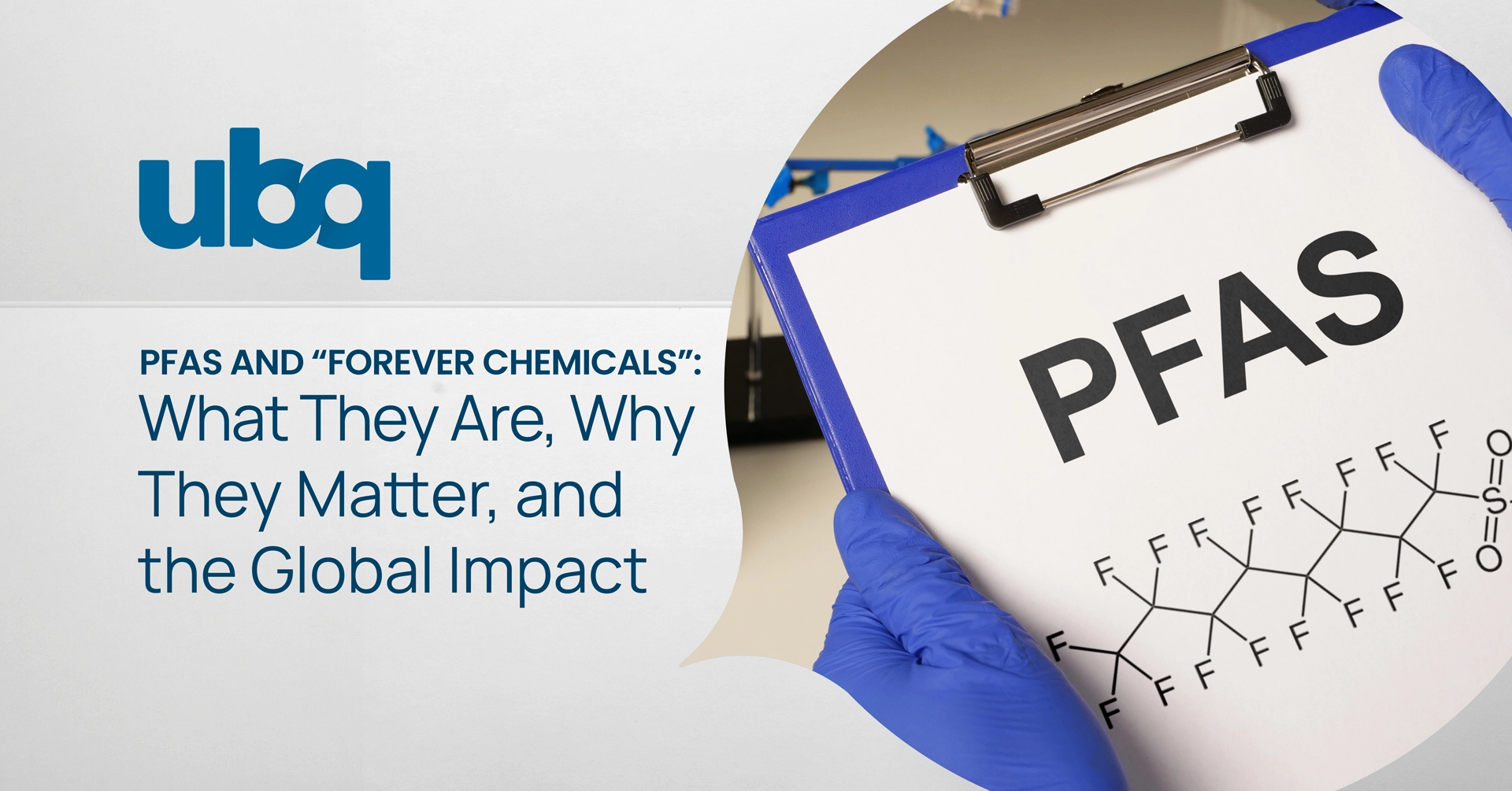
Perfluoroalkyl and polyfluoroalkyl substances, more commonly known as PFAS, are a large family of man-made chemicals that have been used in industrial products and consumer products since the 1940s. There are over 10,000 individual PFAS chemicals in existence, and while they vary widely in structure and application, they all share one defining characteristic: they are extraordinarily difficult to break down.
So, Why Are They Called “Forever Chemicals”?
The nickname “forever chemicals” comes from exactly that, their near-total resistance to degradation. Once PFAS enter the environment, they don’t disappear. They accumulate in water, soil, air, and living organisms, potentially persisting for hundreds of years. As the UK Government noted in its landmark February 2026 PFAS Plan, there is growing evidence that the widespread use of these chemicals has created risks that “will likely remain for hundreds of years”.
Key Traits of PFAS
What makes PFAS particularly concerning isn’t just one property; it’s the combination of several:
- Persistent: PFAS resist breakdown in both the natural environment and the human body. Unlike many other harmful chemicals, they don’t degrade naturally over time.
- Bioaccumulative: PFAS build up in living organisms, including humans, over time. Studies show that most people already have some level of PFAS in their blood.
- Widespread: PFAS are found virtually everywhere, from the most remote Arctic regions to everyday household products in our homes.
These three traits combined make PFAS one of the most pressing challenges in environmental and public health today.
Why Are PFAS So Hard to Break Down?
To understand why PFAS are such a persistent problem, it helps to understand a little of the chemistry behind them.
The Carbon–Fluorine Bond
At the heart of every PFAS chemical is the carbon–fluorine bond, one of the strongest chemical bonds found in nature. Fluorine atoms cling to the carbon chains of these chemicals with extraordinary force, making PFAS highly resistant to heat, water, oil, and chemical reactions. This is precisely what made them so attractive to manufacturers in the first place. Their ability to resist breakdown is what gives non-stick cookware its slippery surface, makes outdoor clothing waterproof, and keeps grease-resistant food packaging intact. But that same stability is exactly what makes PFAS so dangerous in the long run.
Why Nature Can’t Degrade Forever Chemicals
Most harmful chemicals, when released into the environment, will eventually be broken down by bacteria, sunlight, or chemical reactions in soil and water. PFAS are different. Their powerful carbon–fluorine bonds mean they simply resist breakdown by almost anything. Soil microbes can’t digest them. Sunlight can’t degrade them. Even conventional water treatment processes struggle to remove PFAS effectively, meaning they pass through treatment systems and persist in our water supplies.
Long-Term Environmental Build-Up
Because PFAS resist breakdown so completely, they accumulate over time. Every year that PFAS emissions continue, more of these chemicals are added to an already growing burden in our soils, rivers, and oceans. The Forever Pollution Project, a cross-border investigative journalism initiative, mapped nearly 23,000 sites contaminated by PFAS across Europe alone, with a further 21,500 sites of presumptive contamination. That figure represents decades of accumulation, and it will not shrink quickly, even if all PFAS use stopped tomorrow.
This is what separates PFAS from most other forms of pollution. It is not just a problem for today, it is a problem we are locking in for future generations.
Where Are PFAS Found in Everyday Life? 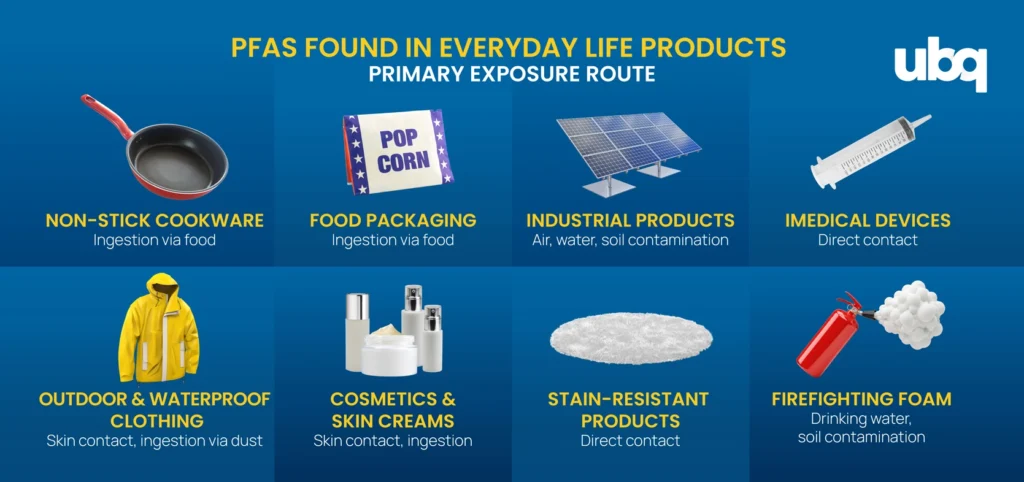
PFAS are not a niche industrial chemical tucked away in factories. They are woven into the fabric of modern life, present in hundreds of everyday products that most of us use without a second thought. These chemicals are found in homes, food, and drinking water, and most people have no idea.
| Source | Product Examples | Primary Exposure Route |
|---|---|---|
| Non-stick cookware | Frying pans, baking equipment | Ingestion via food |
| Food packaging | Pizza boxes, cardboard food packaging, microwave bags | Ingestion via food |
| Outdoor & waterproof clothing | Jackets, school uniforms, fabric treatments | Skin contact, ingestion via dust |
| Cosmetics & skin creams | Makeup, moisturizers | Skin contact, ingestion |
| Firefighting foam | Industrial & military sites | Drinking water, soil contamination |
| Medical devices | Tubing, implants, surgical equipment | Direct contact |
| Stain-resistant products | Carpets, furniture, upholstery | Ingestion via household dust |
| Industrial products | Electronics, solar panels, manufacturing | Air, water, soil contamination |
Consumer Products
The range of consumer products containing PFAS is striking:
- Non-stick cookware: Frying pans and baking equipment coated with non-stick surfaces were among the first mass-market uses of PFAS chemicals. When the non-stick layer becomes scratched or damaged, PFAS can leach into food during cooking. Standard usage at high temperatures can also cause these coatings to volatilize into the air.
- Outdoor clothing and waterproof clothing: Fabric treatments applied to outdoor clothing, school uniforms, and waterproof jackets frequently contain PFAS to make them stain-resistant and water-repellent.
- Cosmetics and skin creams: Many cosmetics and skin creams contain PFAS as ingredients, contributing to daily exposure through skin contact.
- Cardboard food packaging and pizza boxes: PFAS are widely used in cardboard food packaging, including pizza boxes and microwave popcorn bags, to make them grease-resistant. The UK Government’s 2026 PFAS Plan specifically committed to testing these materials for PFAS presence.
- Medical devices: PFAS are used extensively in medical devices due to their durability and chemical resistance, making them difficult to phase out in healthcare settings.
- Bottled water: Research has raised concerns about PFAS contamination in bottled water, with the UK Government also committing to investigating this as part of its 2026 PFAS Plan.
Industrial Uses
Beyond the home, PFAS have been central to a wide range of industrial applications:
- Firefighting foam: One of the most prolific and damaging industrial uses of PFAS has been in firefighting foam, also known as aqueous film-forming foam. For decades, fire services and industrial sites used PFAS-containing firefighting foam routinely, releasing large quantities of toxic chemicals directly into the ground and water. The Angus Fire factory in Bentham, North Yorkshire, legally produced PFAS firefighting foam from 1976 until 2024, and is now at the centre of one of the UK’s most serious PFAS contamination scandals.
- Manufacturing and electronics: PFAS are used in the production of electronics, solar panels, and a wide range of industrial products, valued for their heat resistance and durability.
How PFAS Enter Water, Soil, and Air
PFAS don’t stay where they are applied. They migrate, through rainfall, industrial discharge, and the breakdown of PFAS-containing products, into the wider environment:
- Water: PFAS leach from contaminated land and industrial sites into groundwater and rivers, eventually reaching our drinking water and water supplies.
- Soil: PFAS from landfill sites, agricultural use of contaminated biosolids, and industrial discharge accumulate in soil, where they can persist for decades.
- Air: Some specific PFAS chemicals are volatile and can travel through the air, spreading contamination far beyond the original source.
How PFAS Spread Through the Environment
Once PFAS are released into the environment, they don’t stay in one place. Their chemical stability, the same property that makes them so useful in everyday products, allows them to travel vast distances through water, soil, and air, spreading PFAS contamination far beyond the original source. Understanding how this happens is key to understanding why PFAS pollution is truly a global problem.
Water Contamination
Water is the primary pathway through which PFAS spread through the environment and reach humans. PFAS leach from contaminated land, landfill sites, and industrial sites into groundwater, rivers, and reservoirs. From there, they enter drinking water systems, and conventional water treatment plants are largely unable to remove PFAS effectively, meaning many water companies are unknowingly supplying PFAS-laced water to their customers.
The scale of this problem is already becoming clear in the UK. Groundwater testing at the Angus Fire factory site in Bentham, North Yorkshire revealed the highest known concentrations of PFAS ever recorded in the UK. Blood testing subsequently carried out for a documentary found that around a third of the 39 residents tested had high levels of PFAS in their bloodstreams, with one former factory worker recording a blood PFAS level of 405 nanograms per milliliter, more than 200 times higher than the lower risk threshold.
Soil and Agriculture
PFAS also spread extensively through soil, with serious implications for food safety:
- Biosolids: Sewage sludge, used widely as an agricultural fertilizer, frequently contains PFAS absorbed from household and industrial wastewater. When spread on farmland, it introduces PFAS directly into the soil and food chain.
- Crops and livestock: PFAS in contaminated soil are taken up by crops and consumed by livestock, meaning they can enter the food supply through fruit, vegetables, and meat, as well as through breast milk in nursing mothers.
- Landfill sites: Legacy landfill sites containing PFAS-containing products slowly leach chemicals into surrounding soil and groundwater over many decades, representing a long-term and largely unquantified source of ongoing PFAS emissions.
Wildlife Exposure and the Sentinel Species Concept
PFAS don’t just affect humans; they accumulate throughout the natural environment, working their way up the food chain through a process called ‘bioaccumulation’. Animals at the top of the food chain, such as birds of prey, dolphins, and polar bears, tend to carry the highest concentrations of PFAS in their bodies, having absorbed the chemical burden of everything they have eaten.
This makes certain animals valuable as what scientists call “sentinel species”, early warning indicators of environmental contamination. When PFAS levels in wildlife rise sharply, it signals wider environmental pollution that will, in time, also affect human health. Monitoring these species is therefore a crucial tool in tracking the true scale of PFAS pollution across ecosystems.
The Link Between PFAS and Plastics

PFAS and plastics are two of the most significant environmental challenges of our time, and they are more closely connected than most people realize. Understanding the relationship between them is essential to grasp the full scale of the problem.
Microplastics as Carriers
Microplastics, tiny fragments of plastic that result from the breakdown of larger plastic items, are now found virtually everywhere, from the deepest ocean trenches to human blood. What makes them particularly concerning in relation to PFAS is that microplastic particles can absorb and carry PFAS chemicals, acting as vehicles that transport toxic chemicals through the environment and into living organisms. Once inside the human body, these microplastic carriers can release their PFAS load into surrounding tissues, adding to the overall burden of exposure.
Fluorinated Plastics and Food Packaging
Many plastics are themselves a direct source of PFAS. Fluorinated plastics, plastics treated or manufactured with fluorine-based chemicals, are widely used in industrial products, medical devices, and food packaging precisely because of their chemical resistance and durability. Cardboard food packaging, pizza boxes, and other forms of food contact materials are frequently treated with PFAS to make them grease-resistant and water-repellent, meaning PFAS can migrate directly into the food we eat.
The financial scale of this problem is enormous. A study estimated that chemicals used in plastic materials, including PFAS, contributed to approximately $249 billion in plastic-attributable disease burden in the United States in 2018 alone, equivalent to 1.22% of gross domestic product.
The Wider Plastic Pollution Problem
The connection between PFAS and plastics runs deeper than chemistry alone. Both share the same fundamental problem: they were designed to last, and they do, long after their usefulness has ended. Both accumulate in the natural environment, both enter the food chain, and both are now found in the human body in ways that were never intended or anticipated. Addressing PFAS in isolation, without also confronting the broader plastic pollution crisis, risks missing the bigger picture.
How PFAS Affect Human Health
Of all the concerns surrounding PFAS, their impact on human health is arguably the most urgent. These chemicals enter the human body through multiple routes, accumulate over time, and have been linked to a wide range of serious health conditions.
Key Health Risks
The health risks linked to PFAS exposure are wide-ranging and serious. The World Health Organization has classified perfluorooctanoic acid as possibly carcinogenic, with kidney cancer and testicular cancer showing the strongest associations. Beyond various cancers, PFAS have been linked to immune system suppression, particularly impaired vaccine response in children, as well as thyroid disease, high cholesterol, pregnancy-induced hypertension, and reduced fertility in both men and women. Developmental impacts are especially concerning, as mothers with elevated PFAS levels will pass a significant proportion of that burden to their children through the womb and through breast milk.
How PFAS Affect Animals and Ecosystems
The health risks posed by PFAS extend well beyond humans. Across the natural environment, wildlife is being exposed to harmful chemicals at levels that in many cases far exceed those found in the general human population, with serious consequences for ecosystems.
Bioaccumulation and Biomagnification
Just as PFAS accumulate in the human body, they build up in animals through bioaccumulation, and the effects compound as you move up the food chain. A process known as biomagnification means that top predators such as dolphins, eagles, and polar bears can carry extraordinarily high concentrations of PFAS in their bodies, having absorbed the chemical burden of everything they have eaten. Aquatic species face a particularly direct form of exposure, living in constant contact with PFAS contaminated water and absorbing these harmful chemicals through their gills and skin as well as through their diet.
Animals as Early Warning Signs
This heightened exposure is why certain species are considered “sentinel species”, animals whose health reflects the state of the wider natural environment. When PFAS levels in wildlife rise, or when sentinel species begin showing immune system disruption, hormonal imbalance, or reproductive failure, it signals that the ecosystem is under serious chemical stress and that public health challenges are likely to follow.
What Is the “One Health” Approach?
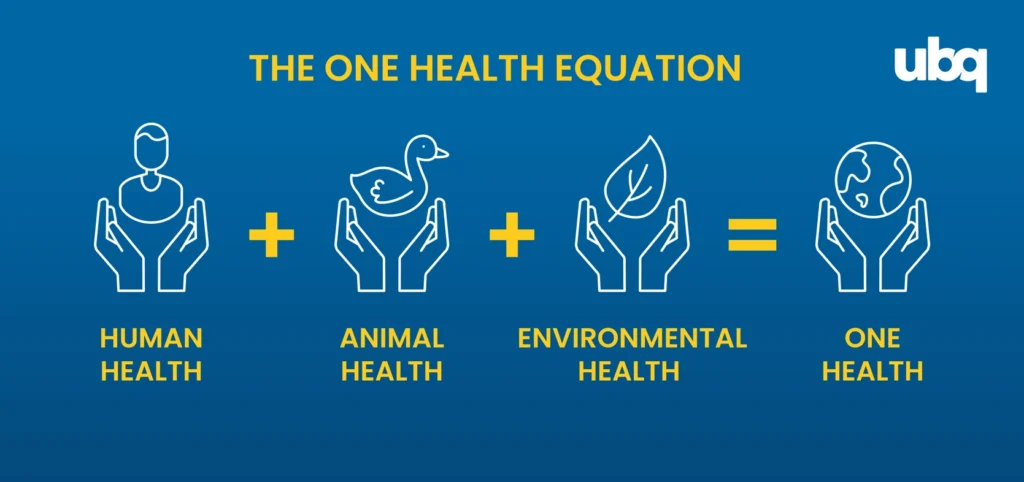
The story of PFAS makes one thing clear: the health of humans, animals, and the environment are not separate issues, they are deeply interconnected. This is the central idea behind the “One Health” approach, a framework increasingly adopted by scientists, policymakers, and public health bodies worldwide.
The One Health Equation
At its simplest, One Health can be expressed like this:
Human Health + Animal Health + Environmental Health = One Health
No part of this equation can be solved in isolation. Damage one, and the others follow.
Why PFAS Requires a One Health Approach
PFAS is perhaps the clearest modern illustration of this principle: chemicals released by industrial and consumer activity accumulate in soil, water, and wildlife, before entering the human food chain and ultimately the human body itself. The same contaminated water supplies that pose health risks to local communities are degrading aquatic ecosystems. The same landfill sites leaching PFAS into rivers are simultaneously threatening both wildlife and public health.
Tackling PFAS effectively cannot be done by looking at human health in isolation. As the Forever Pollution Project’s mapping of nearly 23,000 contaminated sites across Europe demonstrated, PFAS pollution operates at an ecological scale that demands an ecological response. A One Health approach that addresses PFAS across the full spectrum of human, animal, and environmental health simultaneously is essential.
Can PFAS Be Removed or Destroyed?
PFAS can be filtered from drinking water using technologies such as reverse osmosis, but cannot yet be destroyed at scale. They are engineered to resist breakdown, making them extraordinarily difficult to eliminate from the environment or the human body once present.
Filtration vs Destruction
Several technologies can filter PFAS from drinking water, including reverse osmosis and activated carbon systems used by some water companies, but none of these destroy PFAS. They simply capture and concentrate on them, creating a secondary waste problem. Scientists are actively developing true destruction methods, including high-temperature incineration and electrochemical oxidation, but these remain expensive, difficult to scale and carry their own environmental risks.
Why PFAS Are a Global Issue
PFAS are not a localized problem or a challenge that will resolve itself over time. They are a global crisis, built into the fabric of modern industrial life and set to persist for generations regardless of what action is taken today.
Persistence + Scale = A Long-Term Problem
The Forever Pollution Project identified nearly 23,000 confirmed PFAS contamination sites across Europe alone. Even if every source of PFAS emissions were eliminated tomorrow, the chemicals already present in our soils, water supplies, and bodies would remain for centuries.
Better Materials, Monitoring, and Policy
Tackling PFAS requires action on three fronts: a genuine shift toward PFAS-free alternatives, comprehensive monitoring of water, soil, and food chains, and regulation bold enough to make chemical companies bear the cost of cleanup.
The Link to Plastics and Sustainability
PFAS and plastic pollution are products of the same industrial era, the result of prioritizing short-term performance over long-term safety. Both demand a move toward truly circular, sustainable alternatives that work with the natural environment rather than against it.