Key Takeaways
- Military emissions are vast but largely unreported: Armed forces account for ~5.5% of global greenhouse gas emissions, water pollution, soil contamination and waste generation, yet most countries are not required to disclose their military carbon footprint.
- War rapidly accelerates environmental damage: Active conflicts generate massive emissions in short periods, alongside toxic pollution of air, soil, and water and ecosystems that can persist for decades.
- Ecosystems are directly and indirectly destroyed: From ozone depletion caused by missiles to deforestation, wildlife loss, and ocean disruption, conflict damages every layer of the natural environment.
- Supply chains for weapons, fuel, and reconstruction multiply impacts through resource extraction and logistics.
- The climate impact continues long after war ends: Reconstruction, resource exploitation, and ongoing contamination often produce more emissions and long-term ecological harm than the conflict itself.
The scale of the problem at a glance:
Global militaries are responsible for an estimated 5.5% of all greenhouse gas emissions worldwide, more than the entire civil aviation and civilian shipping sectors combined. The U.S. Department of Defense is the largest institutional consumer of fossil fuels in the world and a key contributor to climate change. If the world’s armed forces were their own country, they would rank as the fourth largest polluter on Earth, and yet military emissions are almost entirely absent from international climate agreements.
The environmental footprint extends beyond emissions to include supply chain impacts. Military logistics consume vast quantities of materials and fuel, while global arms production drives mining, deforestation, and industrial pollution. In Ukraine alone, pre-war supply chains for military equipment contributed significant land degradation through rare earth extraction and heavy fuel transport.
Unlike power stations, car manufacturers, or airlines, militaries face no legal obligation to report their carbon footprint to the UN Framework Convention on Climate Change (UNFCCC). Because reporting is voluntary, most countries simply don’t do it. Major military spenders, including Russia, France, Japan, and Turkey, have provided no usable emissions data at all, despite collectively spending hundreds of billions on defense every year. What isn’t measured can’t be reduced, and right now, it’s barely being measured. Military emissions are significantly underreported, with some research suggesting that their actual scale can be ten times higher than officially declared, creating a substantial knowledge gap in understanding their environmental impact.
Active conflicts make the picture significantly worse. The first three years of the Russia-Ukraine war alone generated an estimated 230 million tonnes of CO₂ equivalent, roughly the combined annual emissions of Austria, Hungary, the Czech Republic, and Slovakia. The carbon footprint of military activities, including emissions from fuel consumption and equipment production, is estimated to be around 2,750 million tonnes of CO2 equivalent, which is comparable to the emissions of several countries. Ongoing conflicts across the Middle East in 2026 are adding to that total with every air strike, every convoy, every destroyed industrial facility. These aren’t distant or abstract environmental consequences; they are real, large-scale, and accelerating. In fact, analysis suggests that over 5 million tonnes of CO₂ were emitted in just the first 14 days of the US-led war on Iran, highlighting just how rapidly conflict can drive emissions on a global scale.
Military conflict, such as the Russian invasion of Ukraine, has led to significant environmental damage, with explosions releasing toxic substances like lead and mercury into the environment, contaminating water sources and harming ecosystems. Explosions release lead, mercury, and dioxins that contaminate soil and groundwater, rendering agricultural land unusable.
The Stratosphere: Missile Volleys and Ozone Depletion
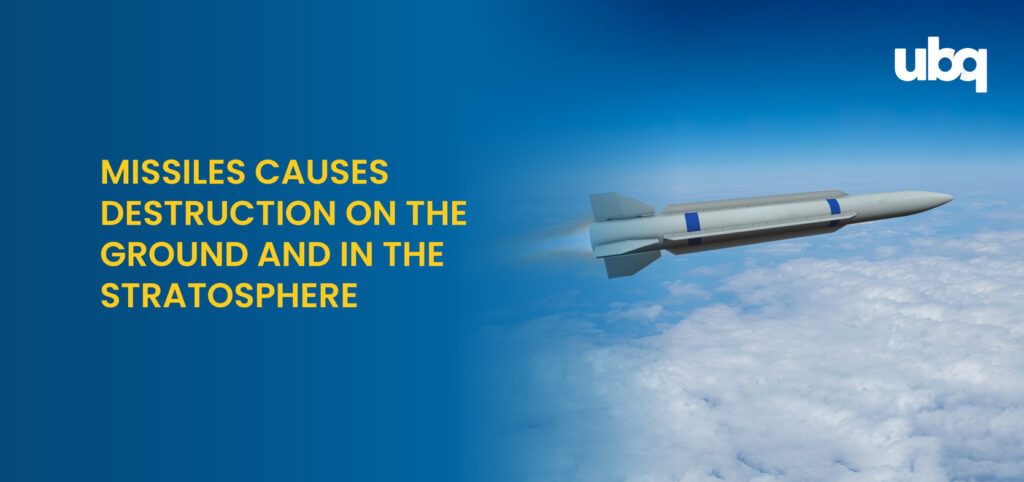
Most people know missiles cause destruction on the ground. Fewer realize they also cause damage high above our heads, in the stratosphere, where the ozone layer shields all life on Earth from harmful UV radiation.
When a ballistic missile launches, it punches through the atmosphere, injecting pollutants directly into the stratosphere. The three main culprits are:
| Pollutant | What it does |
|---|---|
| Black carbon (soot) | Warms the stratosphere, speeding up ozone-depleting reactions |
| Alumina particles (Al₂O₃) | Acts as a reaction surface for chlorine, accelerating ozone destruction |
| Reactive chlorine | Directly strips away ozone molecules |
Unlike pollution released lower in the atmosphere, these particles can remain in the stratosphere for three to four years.
The ozone layer has been slowly recovering since harmful CFCs were banned in the 1990s. But research shows that chlorine from solid rocket propellants and black carbon from most rocket fuels are now threatening to delay that recovery. As modern conflicts involve ever-larger missile exchanges and high-altitude interceptions, the cumulative damage is growing.
The Atmosphere: Greenhouse Gas Emissions and the Reporting Loophole
War is one of the most carbon-intensive activities on the planet, yet it is almost entirely absent from global climate carbon accounting. Under the Paris Agreement, military emissions reporting is entirely voluntary, so most countries simply don’t do it. The US pushed to exempt military emissions from the Kyoto Protocol in 1997. While the Paris Agreement technically removed that exemption, it replaced it with voluntary reporting, meaning few countries bothered. You cannot reduce what you don’t measure. During and after conflicts, economic priorities often take a backseat, leading to limited attention to environmental governance and resource management. Right now, one of the planet’s biggest sources of greenhouse gases operates almost entirely outside the systems designed to hold polluters accountable.
The Ground: Toxic Hotspots and Infrastructure Collapse
When bombs fall on cities, the damage doesn’t end when the dust settles. It sinks into the ground. Explosive weapons destroy buildings, generating debris and releasing hazardous materials including asbestos, industrial chemicals, and fuels. They also destroy water supplies and sanitation facilities, leading to pollution from sewage. That contamination doesn’t stay in one place; it leaches into soil, enters groundwater, and works its way into the food chain, affecting local communities long after fighting has stopped.
In Gaza, an estimated 61 million tonnes of debris have been generated by the conflict, containing unexploded ordnance, toxic chemicals from munitions, and asbestos, posing a lasting public health burden. In Mosul, Iraq, over 7 million tonnes of rubble were left behind after the ISIS conflict, much of it dumped into agricultural land and the Tigris River.
Rather than viewing this rubble solely as waste, it can also be understood as a misplaced resource, material that has been violently displaced from homes, roads, schools, hospitals, and infrastructure, but which still contains recoverable value. This is where the concept of urban mining becomes important. Urban mining looks at the built environment as a source of materials that can be recovered, processed, and reused, from concrete and metals to aggregates and other construction inputs. In post-conflict settings, this does not remove the need for careful clearance, contamination control, and public health safeguards, but it does shift the long-term conversation from disposal to recovery. With the right circular technologies, parts of the debris stream can be transformed from an environmental burden into a resource for rebuilding, reducing pressure on virgin materials while supporting more sustainable reconstruction.
Then there are burn pits – open-air waste incinerators used on military bases to dispose of everything from weapons debris to medical waste. US military burn pits in Iraq and Afghanistan contaminated the surrounding air, groundwater, and soil, exposing both soldiers and local civilians to dangerous pollutants with health consequences that continue to this day.
The Sea: Sonar, Sunken Infrastructure, and Methane Releases
War doesn’t stop at the waterline. Its environmental consequences extend deep beneath the surface, threatening marine ecosystems in ways that are largely invisible to the public.
The most dramatic recent example is the sabotage of the Nord Stream pipelines in September 2022. A UNEP analysis confirmed it was the largest human-caused release of methane ever recorded, up to 485,000 tonnes, nearly five times larger than the previous record holder. In the short term, the leak contributed as much to global warming as 8 million cars driven for a year. It was a single act of conflict-related infrastructure destruction with consequences for the global climate.
Shipwrecks are another slow-burning problem. Thousands of vessels sunk during the Second World War and subsequent conflicts still lie on the seabed, many still containing fuel. As their hulls corrode, they leak oil into surrounding marine ecosystems, a form of environmental contamination that will continue for decades.
There is also naval sonar. Sonar systems used by military forces generate sound waves topping 235 decibels, travelling hundreds of miles underwater, and evidence shows that whales will swim hundreds of miles, rapidly change depth, or beach themselves to escape. Whales exposed to high-intensity sonar have repeatedly stranded and died on beaches around the world, some bleeding from the eyes and ears. Since a sonar ban was introduced around the Canary Islands, mass strandings there have stopped entirely, a clear signal of cause and effect.
The ocean absorbs the environmental harm of armed conflict just as surely as the land does, as carbon sinks in the ocean. It just does so more quietly.
Nature as a Conflict Commodity
War doesn’t just destroy nature; it turns nature into a weapon, a currency, and a casualty all at once. When governance collapses and armed groups move in, the natural environment is among the first things to be exploited.
How Armed Groups Exploit Natural Resources
More than 40% of internal armed conflicts over the last 60 years have been linked to natural resources. Oil, minerals, timber, and wildlife become funding streams for armed groups operating outside the law. Without effective environmental protection or state oversight, entire ecosystems are stripped for profit.
- Illegal mining pollutes rivers with toxic chemicals like mercury, destroys agricultural land, and funds further violence.
- Poaching and wildlife trafficking surges when law enforcement collapses. Elephant populations have been decimated in the DRC and Central African Republic as a direct result.
- Illegal logging clears natural habitats at pace – in Afghanistan, deforestation rates reached 95% in some areas after decades of conflict.
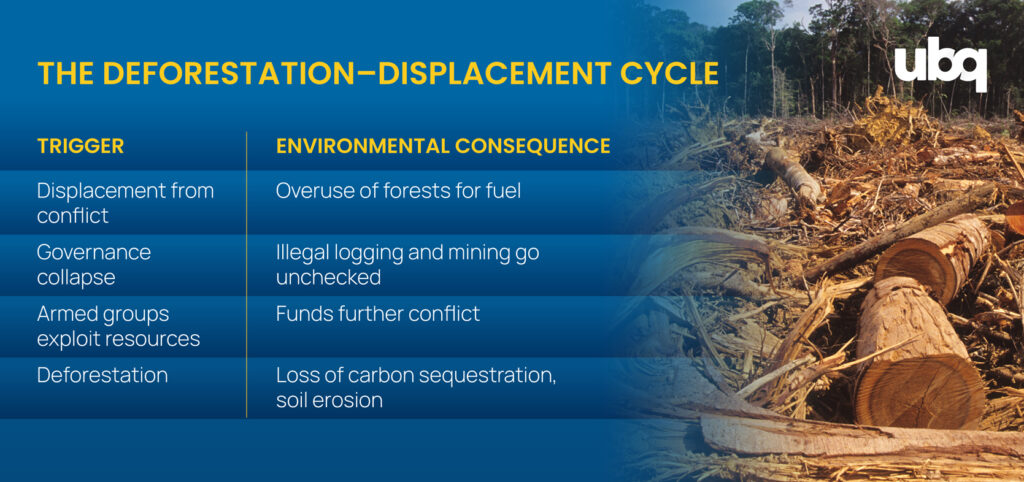
The Deforestation–Displacement Cycle
When people are displaced by armed conflict, they depend on whatever natural resources are around them to survive. Wood and charcoal become essential fuel sources, and forests pay the price.
In Somalia, charcoal production became one of al-Shabaab’s main income streams, earning an estimated $38–56 million annually, while simultaneously accelerating deforestation, soil erosion, and long-term environmental degradation for local communities.
| Trigger | Environmental consequence |
|---|---|
| Displacement from conflict | Overuse of forests for fuel |
| Governance collapse | Illegal logging and mining go unchecked |
| Armed groups exploit resources | Funds further conflict |
| Deforestation | Loss of carbon sequestration, soil erosion |
The Carbon Cost of Peace
Most people assume the environmental damage of war ends when the fighting stops. In reality, for greenhouse gas emissions, the worst may be yet to come.
Rebuilding destroyed cities requires enormous quantities of concrete, steel, and glass, some of the most carbon-intensive materials on the planet. Every bombed hospital, every flattened apartment block, every destroyed bridge must be replaced, and each one carries a significant carbon cost.
The Statistics:
- Ukraine’s post-war reconstruction is estimated to generate 741 million tonnes of CO₂ equivalent over 10 years – nearly three times the emissions produced during the first three years of active fighting
- Post-war reconstruction accounts for an estimated 27% of total emissions from Russia’s invasion of Ukraine
- The carbon cost of reconstructing Gaza alone could exceed the annual greenhouse gas emissions of 135 countries
- Reconstruction emissions from a single conflict can surpass the emissions generated during active combat itself
A Smarter Way to Rebuild
This doesn’t have to be the outcome. The rubble and debris left behind by conflict contains materials that, if properly managed, can be reused rather than replaced with carbon-intensive new production. Crushed concrete can substitute for aggregate. Salvaged steel avoids the need for energy-hungry smelting. Ukraine has already committed to steering its reconstruction towards sustainability criteria, efficient buildings, sustainable building materials, and resilient infrastructure, recognizing that rebuilding the old way would simply compound the environmental damage already done.
The way a country rebuilds after conflict is as important as how it fought. Circular, waste-to-resource approaches to reconstruction aren’t just better for the environment; they’re an opportunity to build something more resilient than what existed before.
The Energy Demand of Modern Warfare
The environmental damage of armed conflict isn’t limited to bombs and battlefields. A vast, largely hidden web of military activities, supply chains, logistics, military bases, training, and weapons manufacturing drives enormous greenhouse gas emissions every single day, with or without a war in progress.
The scale of military fossil fuel consumption is staggering. As much as 80% of the US military’s fuel is consumed by weapons systems – tanks, ships, and planes – with fighter jets being the single biggest driver.
Military bases compound the problem long after conflicts end. Almost 900 of the 1,200 Superfund contaminated sites in the US are abandoned military sites, where fuel spills, toxic chemicals, and burn pit emissions have poisoned local ecosystems, agricultural land, and drinking water, creating public health crises for local communities that persist for generations.
Military emissions fell after the Cold War, but rising military spending and international tensions have reversed that trend entirely. As the climate crisis deepens, excluding military activities from global climate accountability is one of the most significant failures of environmental protection we have.
There is also a growing energy security argument for reducing military dependence on fossil fuels. Militaries are increasingly examining renewables, battery storage, and microgrids not only as environmental measures, but as tools for tactical resilience. Fuel supply lines are vulnerable, expensive, and dangerous to maintain, especially in conflict zones where convoys can become targets. A base, hospital, or command center powered partly by local renewable energy and resilient microgrid infrastructure is less exposed to disruption and less dependent on long-distance fuel logistics. In that sense, decarbonization is not just a climate issue for defense organizations; it is also a question of operational security, energy independence, and long-term resilience.
Making Ecocide a Crime

For most of human history, destroying the environment during armed conflict has carried no legal consequences. That is slowly beginning to change, but progress is frustratingly slow given the scale of environmental harm being caused by contemporary conflicts.
The Rome Statute, which underpins the International Criminal Court (ICC), already recognizes environmental damage as a war crime in certain circumstances. But the threshold is exceptionally high, and environmental protection under the existing framework is restricted almost entirely to wartime contexts, leaving vast areas of military-caused environmental harm completely outside the reach of international law.
The push to change this centers on recognizing ecocide, the large-scale destruction of ecosystems, as a standalone international crime. Military activities, such as drone warfare and habitat destruction, can disrupt ecosystems, significantly altering habitats, threatening biodiversity, and contributing to species extinctions. The introduction of invasive species during military operations can also disrupt ecosystems and lead to biodiversity loss, as these species often outcompete native flora and fauna. In September 2024, Vanuatu, Fiji, and Samoa formally proposed adding ecocide as a fifth crime under the Rome Statute, sitting alongside genocide, war crimes, and crimes against humanity. As of early 2025, fifteen countries have already criminalized ecocide in domestic law, and the European Parliament has moved to treat it as a criminal offence across EU member states.
In December 2024, the ICC’s Office of the Prosecutor released a landmark policy setting out, for the first time, a systematic framework for investigating and prosecuting environmental crimes, making clear that severe ecological harm is not peripheral to international atrocity law, but increasingly central to it.
The environmental consequences of armed conflict, the toxic contamination of agricultural land, the destruction of natural habitats, the long-term ecological consequences for local ecosystems and entire communities, deserve the same legal weight as other war crimes. The world is edging toward that recognition.
Rebuilding for a Resilient Future
The environmental impact of war is no longer a hidden consequence; it is a defining factor in the climate crisis. Across modern armed conflict, the scale of environmental damage is clear, from devastated war zones to polluted military bases and damaged industrial facilities. These environmental consequences extend far beyond the battlefield, degrading natural habitats, contaminating agricultural land, and placing local communities at risk. The environmental harm caused by military operations continues long after fighting ends, shaping local ecosystems and contributing to the wider global climate challenge.
The drivers of this damage are embedded in everyday military activities. From military vehicles and military equipment powered by fossil fuels to the release of greenhouse gases and carbon emissions, the role of military emissions in accelerating climate change cannot be ignored. Add to this the impact of burn pits, toxic chemicals, and wider environmental contamination, and the consequences for human health and public health become unavoidable. Poor air quality, rising air pollution, and long-term health risks are now part of the reality for many living in or near conflict zones.
History shows this is not new. From the Vietnam War and Gulf War to the Iraq War and beyond, the pattern of environmental degradation is consistent. Yet despite rising military spending and renewed international tensions since the end of the Cold War, military forces still operate with limited accountability. Much of the environmental damage and environmental costs linked to military operations remain underreported, even as they contribute significantly to global greenhouse gases.
Building a more resilient future requires a shift in priorities. Environmental protection must sit alongside security, supported by stronger international cooperation and a shared sense of global responsibility. Efforts in environmental remediation, environmental restoration, and sustainable rebuilding can reduce long-term ecological consequences while protecting natural resources and supporting food security.
The environmental cost of war cannot remain an afterthought. Governments, defense organizations, international bodies, and reconstruction partners need to measure military emissions properly, hold environmental damage to account, and prioritize cleaner energy, circular debris recovery, and sustainable rebuilding in conflict response. Security and environmental protection should not be treated as competing priorities. A safer future depends on reducing the harm caused before, during, and after conflict, while rebuilding in ways that protect people, ecosystems, and the resources communities rely on.