Key Takeaways
- UBQ Materials is already operational at commercial scale in Bergen op Zoom. It’s not a pilot or a dream. It’s running today.
- The facility can cut up to 380,000 tonnes of CO₂ per year, equivalent to 1% of Dutch agricultural emissions.
- It could raise the Netherlands’ plastic packaging recycling rate from 49% to over 54%, nearly meeting the 2030 European Union (EU) target today.
- Diverting waste from incineration avoids costs set to rise from €80 to over €200 per tonne by 2030, costs that are legislated, not estimated.
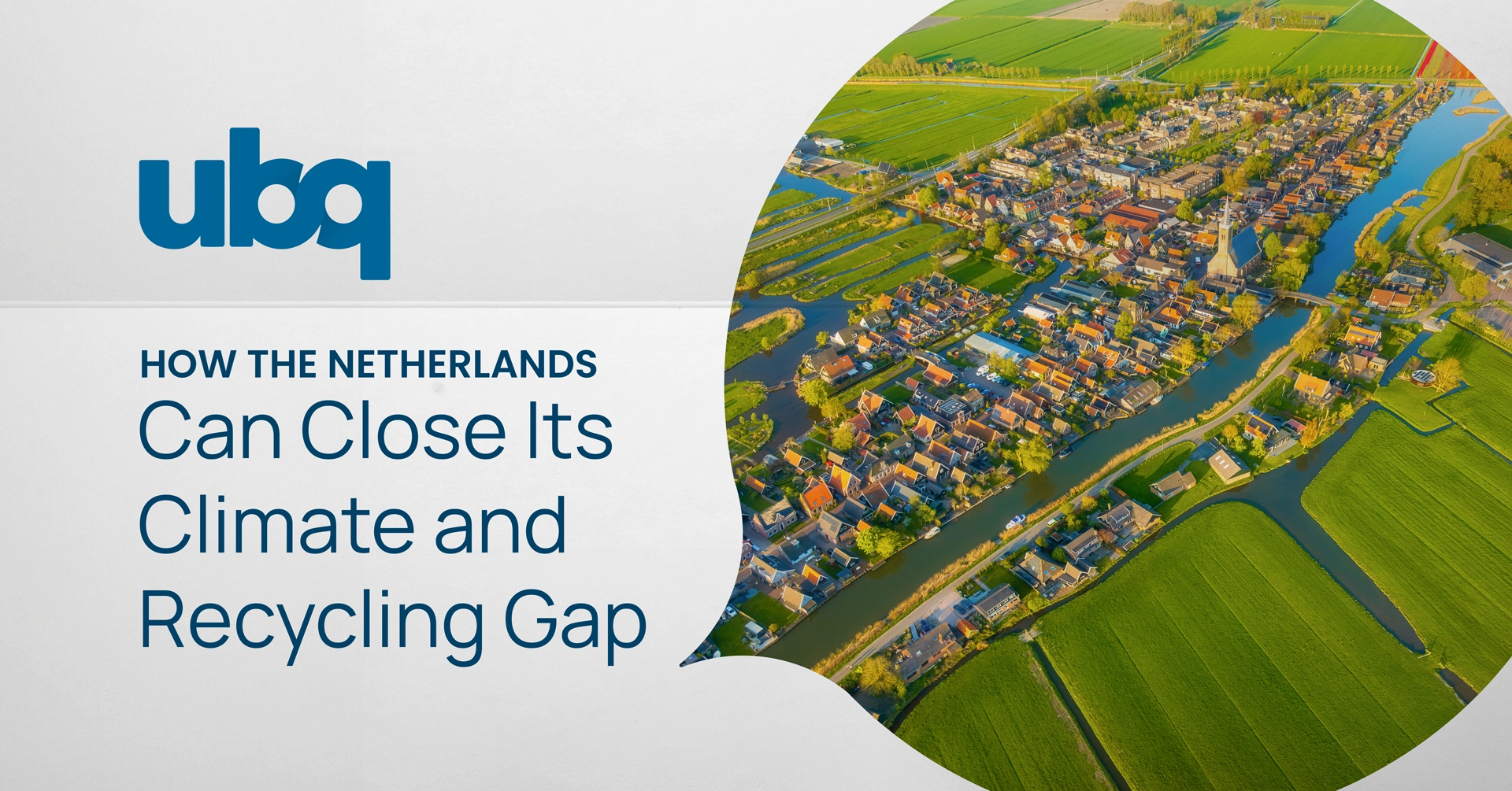
Every day, millions of kilos of household waste disappear into Dutch incinerators. Not because there is no alternative, but because, until now, no one had built a real solution at scale. The Netherlands is legally bound to cut emissions by 55% by 2030. Its plastic packaging recycling rate sits at 49%, below the EU threshold. The cost of burning that waste is set to more than double by the end of the decade. The pressure is real, the deadlines are fixed, and the gap is widening.
There is a solution. It is not a pilot. It is not in a laboratory. It is operating today, at commercial scale, in Bergen op Zoom. UBQ Materials has been operating in the Netherlands since 2024, converting mixed household waste, including hard-to-recycle plastics and organic material, into UBQ™, a cost-competitive alternative to traditional virgin plastic. UBQ Materials tackles the problem where recycling stops. The input is the waste of waste, the contaminated, mixed residual fraction that no conventional recycling process can handle. That garbage, which would otherwise be incinerated, becomes a certified carbon-negative bio-based thermoplastic already used in products by global manufacturers including Mercedes-Benz and McDonald’s.
A here-and-now solution – not a promise, not a pilot
The Bergen op Zoom facility is not a demonstration project. It is a fully operational commercial plant, financed entirely with $340 million in private capital, processing real Dutch household waste today. It can reduce emissions by 286,000 to 380,000 tonnes of CO₂ per year, the equivalent of 1% of the Dutch agriculture sector’s annual emissions, making it one of the only climate solutions already delivering verified abatement at scale on Dutch soil, right now.
Cutting the rising and legislated cost of waste
The cost of burning waste is rising sharply due to national and EU climate policies, with costs anticipated to increase from around €80 per tonne today to over €200 per tonne by 2030. These increases are not speculative; they are legislated. Every tonne of waste sent to an incinerator is a liability that grows year on year. UBQ Materials eliminates that liability entirely. Each tonne diverted from incineration avoids the full cost stack, permanently. Unlike regulatory pledges or future infrastructure plans, the capacity to do this exists today.
Cheaper, stable, and ready to use
One of the most common questions about sustainable materials is whether they cost more and whether they require factories to retool. The answer with UBQ™ is no on both counts.
UBQ™ is already cost-competitive with virgin plastic, and becomes cheaper relative to it every year as carbon pricing rises. Its price is stable, insulated from the commodity swings that make fossil polymer costs unpredictable. It can be adopted into existing production processes without new infrastructure or major factory modifications. Manufacturers can switch without disruption.
Helping the Netherlands achieve recycling targets today
The Netherlands currently recycles around 49% of its plastic packaging, just below EU targets. UBQ Materials addresses the portion of waste that cannot be mechanically recycled. The Bergen op Zoom plant alone could raise the national recycling rate above 54%, bringing the country within reach of its 2030 EU target without waiting for new technology, new plants, or new policy. The infrastructure is already there.
Supporting housing and construction
The Netherlands is facing a housing shortage, partly due to strict environmental requirements for new buildings. UBQ™ has a negative net carbon footprint, meaning it can help reduce the overall environmental impact of construction projects when used in place of higher-carbon materials. In a sector where every gram of CO₂ now carries regulatory and financial weight, a material that actively lowers a building’s carbon score is not just useful, it is a competitive advantage in public tendering and planning approval.
A strategic asset: economically, geopolitically, and industrially
The Netherlands currently depends on roughly 5.5 million tonnes of imported fossil polymers every year. That dependency exposes Dutch manufacturers to volatile global commodity pricing, supply chain disruption, and the growing instability of international trade. The war in Ukraine, shifting US trade policy, and the accelerating fragmentation of global supply chains have made this exposure impossible to ignore.
UBQ™ changes the equation. By converting Dutch household waste into a domestically produced bio-based thermoplastic, it reduces dependency on imported fossil plastics, insulates manufacturers from global price shocks, and creates a secure, locally sourced supply of raw material. That is not just a sustainability argument; it is an industrial and geopolitical one.
Material recovery also creates 1.7 to 2 full-time jobs per 1,000 tonnes processed, compared to 0.1 to 0.3 for incineration. These are high-skill industrial jobs, retained in the Netherlands.
Saving public funds
In addition to reducing emissions, UBQ Materials helps lower national costs. Its current operations could save the Netherlands approximately €24 million per year in EU charges on non-recycled plastic waste.
What UBQ Materials is asking for
The private sector has already done the heavy lifting. $340 million in private investment built the Bergen op Zoom plant without public funding. The technology works, the product is validated, and the customers are there. What remains is a finite funding gap before the plant reaches the volumes at which it becomes fully self-sustaining.
UBQ Materials is working to secure temporary, one-time financial support from the Dutch government to close that gap. Once capacity reaches 50%, the facility is expected to operate without ongoing subsidies, paying back that support through reduced emissions, lower incineration costs, and millions saved in EU plastic levies, year after year.
On the regulatory side, no new legislation is required. What is needed is a decision to formally recognize UBQ Materials’ existing operations and verified technology within current policy frameworks, a ministerial decision, not a parliamentary one. The solution exists. The plant is running. The only question is whether the government will act before the costs of inaction compound further.