Key Takeaways
- The European Green Deal (EGD) is reshaping global trade, mandating climate neutrality, circularity, and zero pollution through legally binding EU laws and frameworks.
- UBQ™, a climate-positive material made from mixed household waste, aligns with the Green Deal’s core pillars by reducing emissions, diverting waste, and replacing virgin resources.
- Regulations like CBAM, PPWR, and Ecodesign apply to any product entering the EU, making UBQ™ a strategic enabler of compliance for companies worldwide.
- Country-specific regulations like France’s AGEC Law and Germany’s Packaging Act further reinforce the need for circular, low-emission materials in local markets.
The European Green Deal (EGD) is more than a sustainability policy; it’s the European Union’s flagship transformation strategy for achieving climate neutrality by 2050. Anchored by binding legislation like the European Climate Law, the EGD sets a legally enforceable pathway to cut greenhouse gas (GHG) emissions by at least 55% by 2030 and to reshape Europe’s economy around sustainability, circularity, and environmental resilience.
The EGD is already shaping the future of industry, production, and trade across and beyond the EU’s borders. Its sweeping policy framework encompasses more than 150 legislative and non-legislative initiatives, covering climate action, waste and pollution reduction, biodiversity protection, sustainable finance, and circular resource use. These are not aspirational goals; they are legally binding reforms already impacting market access, supply chain decisions, and design requirements across the EU.
UBQ’s mission is directly aligned with the goals of the EGD
UBQ Materials’ mission aligns directly with the EGD’s core objectives. UBQ™, a bio-based thermoplastic composite made entirely from mixed household waste, including organics, provides a scalable solution for:
- Achieving climate decarbonization: UBQ™ is inherently climate-positive, reducing GHG emissions and supporting scope 3 decarbonization efforts.
- Enabling circularity: By transforming waste into a valuable material, UBQ™ supports resource efficiency and waste end-of-life diversion.
- Supporting sustainable industry: UBQ™ integrates with ease into existing production lines, making compliance with EU regulations easier for companies worldwide.
As the EU accelerates its green transition, UBQ™ is enabling companies within and outside Europe to meet rising sustainability standards and maintain access to the EU market. In the sections that follow, we’ll explore how UBQ™ fits into the broader Green Deal framework and why it’s a strategic material for navigating the future of sustainable manufacturing.
What is the European Green Deal?
At its core, the EGD sets the binding objective for the EU to become climate neutral by 2050, as established under the European Climate Law. This law also mandates a minimum 55% reduction in GHG emissions by 2030 (compared to 1990 levels), putting legal force behind ambitious interim goals.
But the EGD goes far beyond decarbonization. It serves as a unified framework connecting diverse but interdependent priorities, including:
- Circular economy: Through the Circular Economy Action Plan, the EGD aims to reduce resource consumption and waste generation by promoting reuse, repair, and recycling across product life cycles.
- Zero pollution: The Zero Pollution Action Plan sets targets for clean air, water, and soil, while limiting industrial emissions and toxic chemical exposure.
- Biodiversity restoration: New legally binding targets, supported by legislation like LULUCF (Land Use, Land-Use Change and Forestry) and nature restoration laws, aim to reverse ecosystem degradation and support land-based carbon sinks.
- Sustainable industry and resource efficiency: From the revised Ecodesign for Sustainable Products Regulation to the EU Taxonomy for Sustainable Activities, the Green Deal promotes systemic changes to how products are made, used, and financed.
The scale of the EGD is vast. As highlighted in a report by the European Sustainable Development Network, the Green Deal encompasses over 150 initiatives, many of which have transitioned from proposals to binding legislation, such as the updated EU Emissions Trading System (ETS), Carbon Border Adjustment Mechanism (CBAM), Battery Regulation, and Packaging and Packaging Waste Regulation (PPWR).
This is not a distant goal; it’s a rapidly evolving legislative landscape that is reshaping industries across all EU Member States. The EGD is already influencing what gets produced, how it’s made, and which materials are acceptable under future-facing sustainability criteria. For businesses, compliance is no longer optional.
Who is Impacted by the European Green Deal?
The European Green Deal doesn’t apply to a select few industries or nations; it is reshaping the entire economic landscape of the European Union and beyond. All 27 EU Member States are legally bound to implement and enforce EGD-related legislation, making the Green Deal one of the most comprehensive and far-reaching policy frameworks in the world.
Businesses Operating in the EU
Any company with operations, facilities, or customers within the EU, or companies that are exporting materials and products into the EU, must comply with evolving requirements under the EGD. This includes both manufacturers and service providers who must align their practices with EU sustainability regulations. Several key regulations directly impacting companies include:
- Ecodesign for Sustainable Products Regulation (ESPR): Requires products to meet strict sustainability, durability, and recyclability standards across their entire life cycle.
- Carbon Border Adjustment Mechanism (CBAM): Imposes carbon tariffs on imported goods based on their embedded emissions, leveling the playing field for European producers and placing decarbonization pressure on international suppliers.
- Packaging and Packaging Waste Regulation (PPWR): Introduces targets for recycled content, design for reuse, and reduction of excessive packaging, especially affecting consumer goods and e-commerce.
- Corporate Sustainability Reporting Directive (CSRD) and the EU Taxonomy: Require companies to disclose environmental performance and demonstrate alignment with climate and sustainability goals, affecting financing, investment, and supply chain relations.
These policies apply regardless of where a product is manufactured. If a company is placing goods on the EU market, it must ensure compliance with all applicable EU rules. This creates both pressure and opportunity for companies worldwide to rethink their materials, supply chains, and emissions strategies.
UBQ™: A Strategic Enabler for Compliance
This is where UBQ™ becomes a strategic asset. UBQ™ offers companies a way to:
- Replace fossil-based plastics, virgin or recycled, with a low-impact alternative
- Demonstrate measurable progress toward circular economy and climate goals
- Mitigate Scope 3 emissions and improve ESG performance
- Future-proof products for EU market access
In a world where compliance increasingly determines competitiveness, UBQ™ provides a pathway to innovate responsibly and remain relevant in evolving regulatory markets.
UBQ™: A Material Solution for EGD Compliance
As the European Green Deal accelerates across the European Union, industries face binding requirements to adopt more sustainable practices and materials. The transition to a climate-neutral economy by 2050, with steep greenhouse gas emissions cuts by 2030, requires a fundamental shift away from fossil-based resources and toward circular, low-impact solutions.
Developed by UBQ Materials, UBQ™ is a patented bio-based thermoplastic composite made from mixed household waste, including food scraps and other organics. It converts waste that would otherwise release methane and CO₂ into a climate-positive material, locking biogenic carbon into durable goods and supporting EU goals for carbon mitigation.
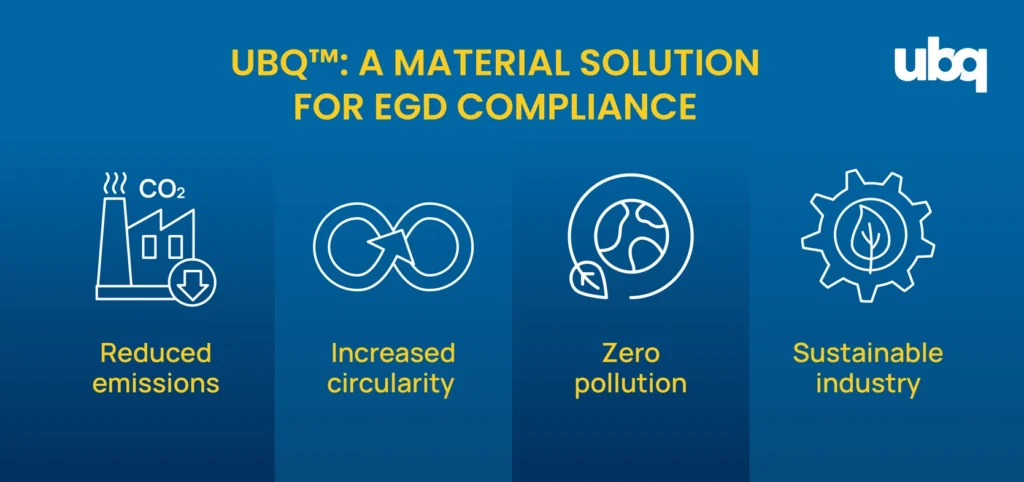
UBQ™ ’s mission directly supports several pillars of the European Green Deal, including:
1. Circular Economy Action Plan
UBQ™ diverts waste from landfills and waste incinerations, reduces dependence on virgin and recycled polymers, and promotes resource-efficient production. By substituting conventional plastics with UBQ™, manufacturers enable waste circularity, support sustainable industry, and close the loop in the material lifecycle, key components of the circular economy transition.
2. Climate Action
In contrast to many conventional materials with high production-phase emissions, UBQ™ helps reduce carbon emissions at the manufacturing stage. By replacing virgin, oil-based inputs with a material made from mixed household waste, UBQ™ supports companies in lowering upstream Scope 3 emissions from manufacturing production and advancing their decarbonization goals in line with European climate targets.
3. Zero Pollution
UBQ™’s production process has zero operational emissions, zero operational water usage, and no toxic byproducts, advancing the objectives of the Zero Pollution Action Plan and creating a toxic-free environment for future generations.
4. Sustainable Industry
UBQ™ is a pioneering material compatible with existing plastics manufacturing infrastructure. It enables a fast, cost-effective transition to sustainable practices without retooling quality or performance, essential for a competitive economy under the EU Green Deal.
By incorporating UBQ™, companies can meet evolving EU law requirements and demonstrate leadership in the green transition. It’s not just a material, it’s a compliance-ready platform for climate change mitigation, industrial strategy, and long-term resilience.
Country-Level Relevance
While the European Green Deal sets a unified framework for the entire European Union, each EU Member State is responsible for implementing the strategy through national legislation and policy measures. These country-specific efforts are translating Green Deal goals into tangible rules, accelerating the green transition across Europe, and pushing industries to adopt more sustainable practices.
France: AGEC Law
France is leading with its Anti-Waste for a Circular Economy Law (AGEC), a policy that supports the Green Deal’s circular economy goals. The law enforces stricter rules on product durability, repairability, recyclability, and labeling, aiming to reduce natural resource use and prevent waste. It also sets mandatory requirements for the use of recycled content in packaging, making sustainable materials like UBQ™ an ideal fit for compliance with tertiary packaging.
Germany: Packaging Act (VerpackG)
Germany’s Packaging Act aligns with the EU’s Packaging and Packaging Waste Regulation (PPWR). It mandates producer responsibility for packaging placed on the market, and promotes recyclability, reduced carbon emissions, and resource efficiency. Companies using UBQ™ can leverage its climate-positive profile and compatibility with recycling systems to meet Germany’s strict eco-design standards on tertiary packaging.
Zero-Emission Buildings Across Europe
As part of the Energy Performance of Buildings Directive (EPBD), several countries, including the Netherlands, Sweden, and Denmark, are enacting Zero Emission Building standards. These require construction materials with low embodied carbon and minimal environmental impact. UBQ™, which locks biogenic carbon into products and eliminates emissions from production, supports this shift by offering a carbon-neutral alternative for energy-intensive industries like construction.
UBQ™: A Localized Solution for a Pan-European Challenge
The fragmented nature of national regulations makes compliance complex for companies operating across multiple EU markets. UBQ™ offers a consistent material that helps businesses localize compliance while maintaining production efficiency.
- Performance parity ensures UBQ™ can substitute conventional plastics without requiring new processes.
- Low and stable environmental impact supports alignment with both EU-wide and country-level targets.
- Scalability and supply chain adaptability make it easier for brands to respond to evolving environmental regulations without delays or disruptions.
As more EU countries implement the European Green Deal aims through their national frameworks, UBQ™ becomes a key enabler of regional alignment and a strategic partner for navigating regulatory complexity.
For Companies Outside the EU: Why This Still Matters
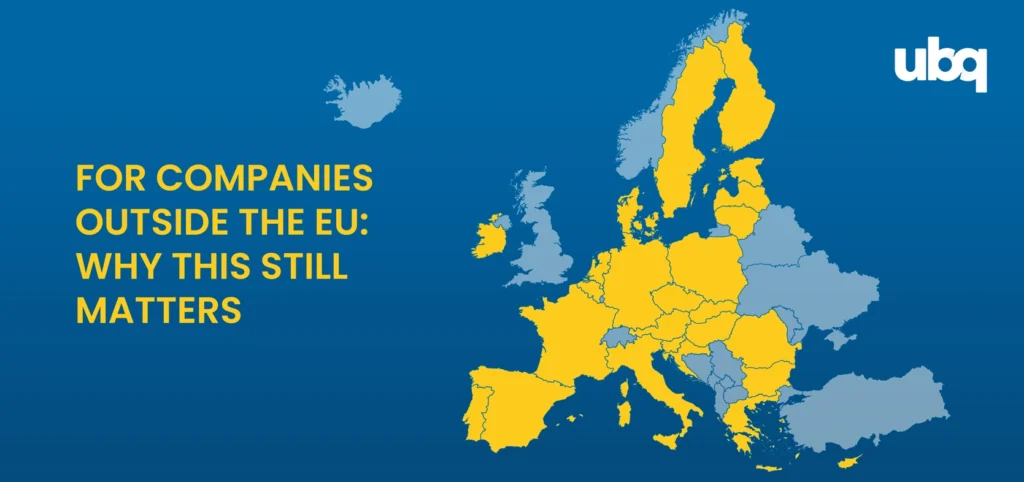
The European Green Deal is not limited by geography. Although it is a legislative framework for the European Union, its impact extends far beyond EU Member States. For companies outside the EU, the Green Deal’s policies are already reshaping access to the European market and defining what it means to compete in global markets under new climate and sustainability expectations.
Carbon Border Adjustment Mechanism (CBAM)
One of the clearest examples of the Green Deal’s global influence is the Carbon Border Adjustment Mechanism (CBAM). CBAM requires importers of emissions-intensive goods, such as aluminum, cement, and plastics, to report and eventually pay for the carbon emissions embedded in their products.
This marks a shift in trade dynamics: carbon neutrality and climate change mitigation are no longer voluntary commitments but part of enforceable trade policy. Companies that cannot demonstrate low-emission production processes risk competitive disadvantages or outright exclusion from the EU market.
UBQ™: A Decarbonization Pathway for Exporters
For exporters, particularly those in energy-intensive industries, UBQ™ enables a clear solution. UBQ™ significantly reduces emissions in product lifecycles. It enables companies to embed biogenic carbon in durable goods, cutting overall greenhouse gas emissions and improving scope 3 performance, critical under CBAM and other evolving EU frameworks.
UBQ™ production requires zero operational water, generates zero pollution, and operates entirely on certified renewable energy sources. These features help companies meet the EU’s environmental objectives while aligning with broader sustainable practices and sustainable investments trends in procurement and supply chains.
Circular Economy & Zero-Waste Expectations
As the EU continues to advance its Circular Economy Action Plan, preference is increasingly given to suppliers and manufacturers who support waste prevention, resource efficiency, and the creation of a toxic-free environment. UBQ™ contributes to all of these by:
- Diverting waste from landfill and incineration
- Replacing virgin, fossil-based materials
- Reducing environmental footprint across the supply chain
For companies responding to EU tenders, public procurement, or engaging with sustainability-focused retailers and brands, the use of UBQ™ can be a competitive advantage, showcasing a commitment to sustainable and smart mobility, sustainable energy, and climate-neutral production.
The EGD Doesn’t Stop at EU Borders
The key message is clear: compliance with the European Green Deal is becoming a global business requirement, not just a regional one. Regulations like CBAM, PPWR, and Ecodesign standards for Sustainable Products are already influencing design, sourcing, and reporting practices worldwide.
UBQ™ is your partner in meeting this new global standard. Whether you manufacture inside or outside of the EU, UBQ™ empowers your products to meet regulatory thresholds, reduce climate impact, and contribute to a fair and prosperous society on a climate-neutral continent.
A Practical Path to Green Deal Readiness
The European Green Deal represents a pivotal shift in how economies grow, industries operate, and materials are sourced and used. With legally binding targets for climate neutrality, deep cuts in greenhouse gas emissions, and a sweeping push toward sustainable practices, it is both a challenge and an opportunity for businesses worldwide.
This transformation is already underway, and it’s accelerating. Companies that act now to align with the green transition can position themselves as leaders in innovation, resilience, and responsibility. Those who delay risk falling behind in a marketplace that increasingly prioritizes low-emission, circular economy solutions and compliance with EU law.
UBQ™ is more than a material; it’s a strategic enabler of sustainable transformation. UBQ™ helps manufacturers reduce their carbon footprint, eliminate waste, and future-proof their products for access to the European economy and beyond.
Whether you’re navigating carbon neutrality goals, responding to Ecodesign directives, or adapting to regulations like CBAM, UBQ™ offers a pathway to measurable impact and long-term value.