Key Takeaways
- Which LEED and BREEAM categories (Materials & Resources, Indoor Environmental Quality, Waste, Innovation, etc.) UBQ addresses and how.
- How incorporating UBQ can reduce embodied carbon, divert waste and contribute measurable sustainability impact in construction materials.
- Why sustainability certification is increasingly not optional, how regulatory pressure and market demand are reshaping the construction sector.
- Practical application areas of UBQ (flooring, insulation, roofing, pipes) and how using it can help projects gain extra “innovation” or “circular economy” credits.
The building and construction sector is responsible for 37% of global emissions, with 11% coming from materials and manufacturing. Addressing this impact is crucial for creating a more sustainable future. UBQ Materials provides an innovative, climate-positive material that not only reduces embodied carbon but also supports compliance and projects that meet sustainability certification requirements, such as LEED and BREEAM.
The Role of Sustainability Certifications in the Building & Construction Industry
Sustainability certifications such as LEED (Leadership in Energy and Environmental Design) and BREEAM (Building Research Establishment Environmental Assessment Method) have become a necessity in the modern building and construction landscape. These certifications validate a project’s commitment to environmental responsibility, reducing carbon footprints, and ensuring energy efficiency.
Why Certifications Matter
- Market value and competitiveness – Certified Buildings often demand higher rents and sales prices, enhancing their market appeal.
- Operational savings – LEED certified buildings, for example, consume on average 25% less energy and 11% less water, leading to significant cost reductions.
- Health and well-being – Certified buildings help ensure improved indoor air quality, resulting in better occupant health, comfort, and productivity.
- Regulatory compliance – As regulations increasingly target embodied carbon reduction, certified projects position themselves ahead of the curve.
Comparing LEED and BREEAM
While Both LEED and BREEAM assess the sustainability of buildings, they differ in their areas of focus:
| Feature | LEED | BREEAM |
|---|---|---|
| Categories | 9 | 10 |
| Emphasis | Strong focus on energy efficiency and carbon reduction | Broad scope, including land use, ecology, and transport |
| Regional Adaptability | Regional Priority credits adjust for local concerns | The criteria adapt to different countries and regions |
| Weighting | More weight on Energy and Atmosphere | More weight on Management and Materials |
| Innovation | Rewards innovative strategies within broader categories | Has a dedicated category for innovation |
| Health & Well-being | Integrated into Indoor Environmental Quality | A standalone category with more emphasis on occupant health |
| Management | Integrated into various categories | A standalone category focusing on lifecycle management |
How UBQ Contributes to LEED and BREEAM Ratings
The building and construction sector is responsible for 37% of global emissions, with 11% coming from materials and manufacturing. Addressing this impact is crucial for creating a more sustainable future. UBQ Materials provides an innovative, climate-positive material that not only reduces embodied carbon but also aligns supports compliance and projects meet with sustainability certification requirements, such as LEED and BREEAM.
Here’s how UBQ Materials supports key LEED and BREEAM categories:
1. Materials & Resources (LEED) / Materials (BREEAM)
UBQ’s Contribution:
- UBQ holds a UL 2809 certification for recycled content and material transparency.
- Sustainable material sourcing – Supports responsible sourcing requirements.
- Circular economy benefits – By using UBQ™, developers and manufacturers promote closed-loop material use, reducing waste and reliance on virgin resources.
Application Areas:
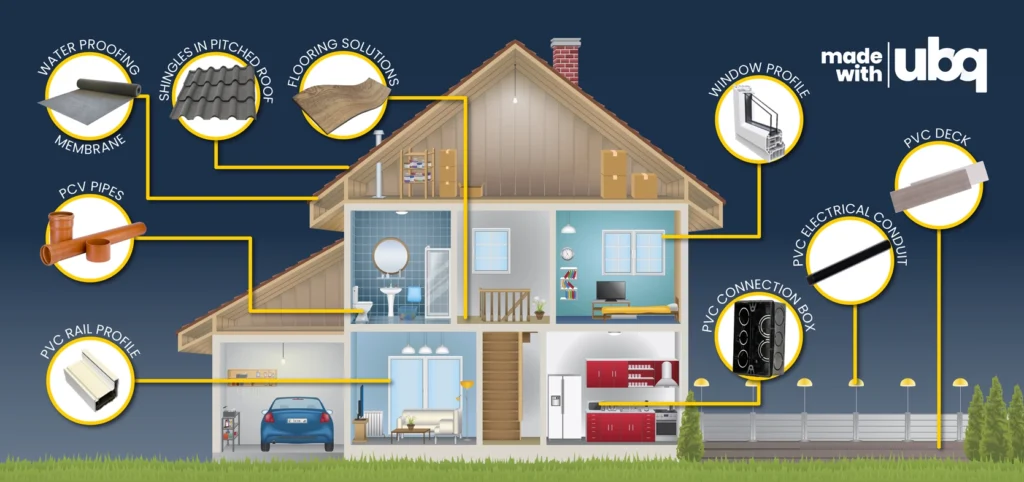
- Pipes and fittings
- Flooring
- Roofing
- Insulation
2. Indoor Environmental Quality (LEED) / Health & Well-being (BREEAM)
UBQ’s Contribution:
- Sustainable building materials – UBQ™ helps improve indoor air quality by minimizing harmful VOC and SVOC emissions.
Application Areas:
- Flooring
- Insulation
3. Waste Reduction (LEED & BREEAM)
UBQ’s Contribution:
- Reduction of organic waste – UBQ™ diverts waste from landfills and incinerations, significantly reducing overall material disposal.
- Minimizes production waste – UBQ’s process ensures that nothing goes to waste, supporting zero-waste goals.
Application Areas:
- All building applications
4. Innovation (LEED & BREEAM)
UBQ’s Contribution:
- Advanced sustainability technology – UBQ™ introduces an innovative approach to material circularity, transforming waste into valuable resources.
- Climate-positive impact – By incorporating UBQ™, projects can earn additional innovation points for significant carbon reduction.
Application Areas:
- 3D printing for construction
- Circular product manufacturing
5. Management (BREEAM)
UBQ’s Contribution:
- Lifecycle assessment support – UBQ™ facilitates a data-driven approach to tracking material impact throughout its lifecycle.
- Sustainable supply chain integration – UBQ promotes responsible sourcing, ensuring sustainability is embedded across production processes.
Application Areas:
- All building applications
Why UBQ is the Ideal Choice for Sustainable Building Projects
- Measurable Carbon Impact: UBQ™ reduces the carbon footprint of materials by up to 1.02 kg CO2eq per kg of material (depending on the % of material used), directly supporting LEED and BREEAM carbon reduction goals.
- Regulatory Compliance: UBQ™ helps companies and projects meet emerging embodied carbon regulations emerging in markets like California and Netherlands.
- Immediate Sustainability Gains: Unlike future sustainability pledges, UBQ™ enables immediate improvements in environmental impact today.
By incorporating UBQ™ into building materials, developers, architects, project managers, and manufacturers can boost their green certification scores, reduce emissions, and contribute to a circular economy without compromising performance or cost-effectiveness.