Key Takeaways
- Environmental transparency is now essential for credible sustainability claims, as regulators, procurement teams, and ESG frameworks increasingly require verified, data-backed disclosures.
- Life cycle assessments (LCAs) provide the scientific foundation for understanding environmental impact, enabling organizations to quantify emissions, resource use, and trade-offs across a product’s full life cycle.
- Environmental Product Declarations (EPDs) translate LCA data into standardized, third-party-verified disclosures, supporting procurement decisions, regulatory compliance, and product comparability.
- Through its third-party-verified LCA and pursuit of an EPD, UBQ Materials demonstrates how measurable data can turn sustainability from ambition into accountable action.
Why Environmental Transparency Matters
The global shift toward sustainable, circular, and low-emission systems is reshaping how companies operate, and how they are evaluated. As climate action becomes a strategic priority, transparency around environmental impact is no longer a differentiator; it’s a requirement.
Organizations face growing pressure to validate their sustainability claims with credible, science-based data. Regulatory frameworks like the EU’s Corporate Sustainability Reporting Directive (CSRD), Sustainable Finance Disclosure Regulation (SFDR) and Packaging and Packaging Waste Regulation (PPWR), along with requirements outside the EU and in some US states, are accelerating this shift, placing measurable impact at the heart of ESG reporting, sustainable procurement, and product development.
For procurement teams selecting materials or R&D teams optimizing product performance, access to clear environmental data can be a deciding factor. Transparency isn’t just about optics; it enables informed decision-making, drives accountability, and empowers businesses to align with emissions reduction and circularity targets.
At UBQ Materials, we recognize that credible, verifiable data is the foundation of climate accountability. Our third-party-verified assessment equips partners with the information they need to make confident, impact-driven choices.
What Is a Life Cycle Assessment (LCA)?
A life cycle assessment (LCA) is a comprehensive, science-based methodology used to evaluate the environmental impact of a product, process, or system across its life cycle, from raw material extraction onward. This “cradle-to-gate” (cutting off when the product leaves the factory) or “cradle-to-grave” (extending all the way through end of life) approach quantifies key environmental indicators, including greenhouse gas emissions, energy and water use, and resource depletion.
Developed in accordance with international standards (ISO 14040 and ISO 14044), LCAs help identify environmental “hotspots” and inform strategies to reduce environmental burdens. They serve as a critical foundation for sustainable product development, ecodesign, and future environmental disclosures such as Environmental Product Declarations (EPDs), particularly when developed in line with relevant Product Category Rules (PCRs).
UBQ’s LCA Status
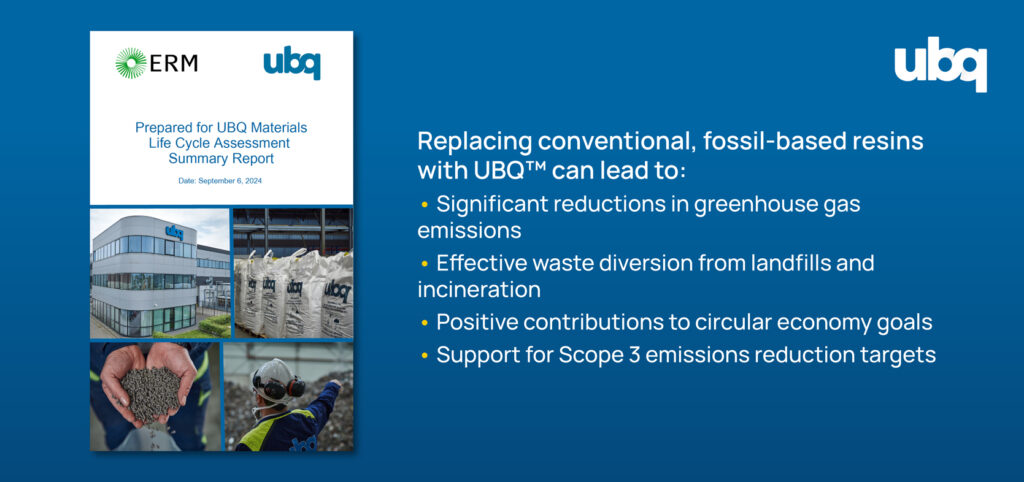
UBQ™ has completed a third-party verified, cradle-to-gate LCA conducted by ERM, a global leader in environmental and sustainability consulting. The assessment was based on designed data for UBQ’s patented thermoplastic composite and evaluated the material’s environmental performance from raw waste input through to pellet production.
Key findings from the LCA confirm that UBQ™ production results in:
- Low greenhouse gas emissions
- Diversion of waste from landfills and incineration
- Overall climate-positive performance
These verified outcomes establish a strong scientific basis for UBQ’s climate claims, while also supporting the sustainability strategies of our partners. When compared with published LCA databases such as ecoinvent, these results show that substituting conventional fossil-based materials leads to significant reductions in greenhouse gas emissions. The LCA is instrumental not only in internal product development but also in external communications, procurement, and ESG reporting.
What is an Environmental Product Declaration (EPD)?
An Environmental Product Declaration (EPD) is a standardized, third-party-verified document that communicates a product’s environmental performance across its life cycle. Built directly from life cycle assessment (LCA) data, an EPD provides clear, quantifiable metrics across multiple environmental impact categories, such as:
- Global warming potential (carbon footprint)
- Water consumption
- Ozone depletion
- Acidification and eutrophication
- Resource use and depletion
EPDs are governed by internationally recognized standards, ISO 14025 and, for construction products, EN 15804, and must follow Product Category Rules (PCRs) that ensure consistency and comparability within a specific product group. This structure enables fair comparison between materials serving the same function.
Importantly, an EPD is not a certification and does not rate whether a product is “good” or “bad”. Rather, it offers a transparent, objective disclosure of environmental impacts, empowering stakeholders to make informed decisions based on standardized data.
For manufacturers, EPDs strengthen participation in green procurement programs, support regulatory compliance, and help meet requirements for certification schemes such as LEED, BREEAM, and DGNB. For specifiers, buyers, and sustainability professionals, EPDs are a trusted resource for product evaluation and carbon accounting.
UBQ’s EPD Status
UBQ Materials is currently in the process of preparing EPDs for priority applications and markets. This complex undertaking involves deep data collection, adherence to strict PCRs, and third-party verification, all essential steps toward ensuring transparency, comparability, and compliance.
UBQ’s pursuit of an EPD reflects its commitment to measurable climate action and its leadership in environmental disclosure for the materials industry.
LCA vs. EPD: What’s the Difference?
While life cycle assessments (LCAs) and Environmental Product Declarations (EPDs) are closely linked, they serve distinct roles in evaluating and communicating a product’s environmental impact.
An LCA is the technical foundation, a detailed environmental analysis used to understand and improve a product’s sustainability profile. An EPD is the public-facing expression of that analysis, standardized, third-party verified, and intended for external disclosure.
This table shows how the LCA and EPD compare:
| Feature | Life Cycle Assessment (LCA) | Environmental Product Declaration (EPD) |
|---|---|---|
| Purpose | Analyze and quantify environmental impact | Publicly disclose LCA results in a standardized format |
| Verification | Can be internal or third-party | Must be verified by an accredited third party |
| Format | Technical report | Standardized, accessible document |
| Standards | ISO 14040 / ISO 14044 | ISO 14025, EN 15804 (for construction materials) |
| Use Case | R&D, sustainability strategy, internal assessments | Procurement, ESG reporting, compliance, green building |
| Audience | Internal teams, product developers, sustainability leads | External stakeholders, certifiers, public tenders, customers |
| Impact Coverage | Can include multiple impact categories | Reports a standardized subset defined by PCRs |
| Data Requirements | Can be based on design or modeled data | Must be based on real-life operational data |
In short:
- LCA gives you the science.
- EPD gives you the verified, shareable proof.
Both are essential tools for advancing credible, data-backed sustainability in product design, procurement, and regulatory reporting.
Why UBQ™ Uses LCA, and What’s Next
At UBQ Materials, life cycle assessment (LCA) is not just a reporting tool, it’s a foundation for product innovation, partner collaboration, and credible climate action. By quantifying environmental impacts at every stage of our material life cycle, we ensure that our sustainability claims are rooted in verifiable data.
The LCA was conducted by ERM (Environmental Resources Management), a globally recognized sustainability consultancy with deep expertise in environmental science, corporate responsibility, and lifecycle modeling. ERM’s verification adds a high level of credibility and scientific rigor to UBQ’s climate claims.
Key results from the LCA, when compared with published LCA databases, demonstrate that replacing conventional, fossil-based resins with UBQ™ can lead to:
- Significant reductions in greenhouse gas emissions
- Effective waste diversion from landfills and incineration
- Positive contributions to circular economy goals
- Support for Scope 3 emissions reduction targets
This data empowers UBQ and its partners to move beyond high-level sustainability messaging, toward measurable, science-backed impact.
What’s Next: Preparing for EPDs
Building on the strength of our verified LCA, UBQ is actively preparing Environmental Product Declarations (EPDs) for select products and markets. EPD development is a rigorous, multi-step process involving:
- Collection of real-world operational data
- Alignment with applicable Product Category Rules (PCRs)
- Third-party verification under ISO 14025 and EN 15804 standards
While EPDs are not yet published, our pursuit reflects a strategic commitment to environmental transparency, regulatory readiness, and partner enablement in sectors where verified disclosures are becoming essential.
What Partners Can Do with UBQ’s LCA
UBQ’s third-party-verified, cradle-to-gate life cycle assessment isn’t just a validation of our own environmental impact; it’s a powerful tool for our partners.
In today’s landscape of increasing regulatory complexity and heightened sustainability expectations, verified environmental data enables our partners to act with clarity, confidence, and credibility.
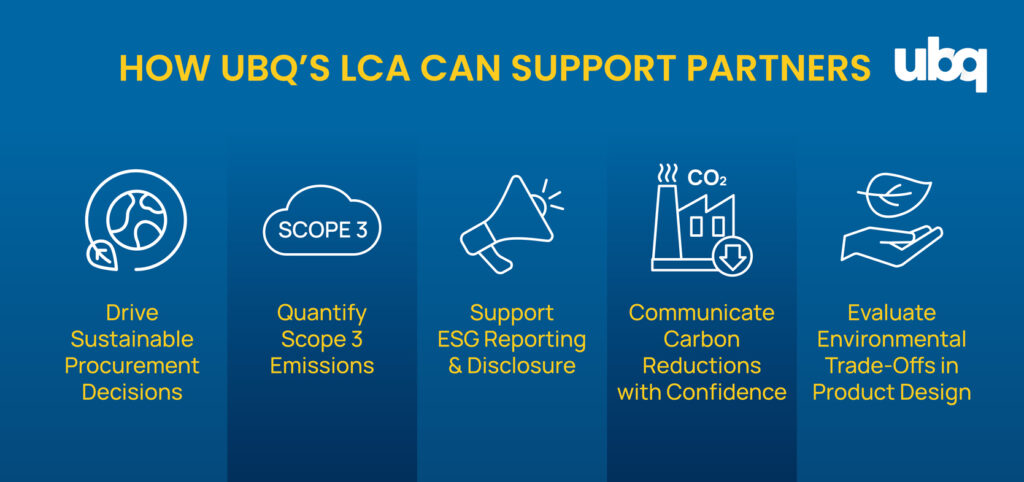
How UBQ’s LCA Can Support Partners:
- Drive Sustainable Procurement Decisions
Choose materials with demonstrably lower environmental footprints to meet green procurement criteria, reduce embodied carbon, and support circular sourcing. - Quantify Scope 3 Emissions
Incorporate UBQ’s LCA data into your upstream emissions calculations, supporting more accurate corporate carbon inventories and SBTi-aligned climate targets. - Support ESG Reporting & Disclosure
Use verified, third-party LCA results to substantiate environmental claims in annual reports, investor communications, and regulatory disclosures. - Communicate Carbon Reductions with Confidence
Translate material choices into measurable emissions reductions that resonate with customers, certifiers, and stakeholders. - Evaluate Environmental Trade-Offs in Product Design
Inform R&D and ecodesign teams with science-backed insights to optimize material selection and reduce lifecycle impacts.
By integrating UBQ™ into products and supply chains, our partners are equipped not just to talk about sustainability, but to prove it, with quantifiable, climate-positive results.
The Role of EPDs in UBQ’s Journey
As global demand for environmental transparency intensifies, Environmental Product Declarations (EPDs) are becoming a strategic requirement, especially in sectors like construction, manufacturing, and public procurement.
Governments and regulatory bodies are embedding EPD requirements into green public procurement (GPP) criteria and embodied carbon regulations, particularly in the EU and other high-regulation markets. Certification systems such as LEED, BREEAM, and DGNB also increasingly require EPDs for material credits and carbon accounting.
Why EPDs Matter for UBQ
For UBQ Materials, developing EPDs is a natural next step in our sustainability journey. Building on the robust foundation of our third-party-verified, cradle-to-gate LCA, our forthcoming EPDs will:
- Translate UBQ’s impact into a globally recognized disclosure format
Enabling clear, standardized communication of our material’s environmental performance. - Enable direct comparisons with alternative materials
Supporting informed selection by procurement professionals, specifiers, and sustainability teams. - Reinforce UBQ’s credibility in climate-positive innovation
Providing another layer of transparency for partners seeking verified, high-performance solutions. - Support compliance with emerging regulations
Including EU Product Environmental Footprint (PEF) methodologies, Extended Producer Responsibility (EPR) frameworks, and international reporting requirements.
UBQ is actively preparing EPDs for priority product applications, aligning with the most relevant Product Category Rules (PCRs) to ensure consistency and comparability.
This next phase in our disclosure strategy underscores our long-term commitment to verified sustainability, market relevance, and climate accountability.
Turning Waste into Quantified Impact
UBQ Materials is redefining how the world sees waste—not as a problem to be managed, but as a resource to be transformed. Our patented process converts the most complex household waste streams, including organics and traditionally non-recyclable materials, into UBQ™, a high-performance, climate-positive thermoplastic composite.
Through our third-party verified, cradle-to-gate life cycle assessment, we’ve turned this transformation into a measurable impact. The data confirms that using UBQ™ can significantly reduce greenhouse gas emissions, support circular economy goals, and contribute to Scope 3 emission reductions for our partners.
While full Environmental Product Declarations (EPDs) are currently in development, the science is already clear. UBQ™ delivers quantifiable environmental value today, and our verified LCA empowers partners to act with confidence and credibility.
By integrating UBQ™ into products, processes, and supply chains, our partners take a meaningful step toward transparency, accountability, and climate leadership.