Key Takeaways
- Thermoplastics soften reversibly when heated and re-solidify when cooled, making them moldable, reusable and recyclable – unlike thermosets, which cannot be remelted.
- The two main structural types are crystalline thermoplastics (such as polyethylene and polypropylene) and amorphous thermoplastics (such as PVC, polystyrene, and ABS).
- Thermoplastics are used across virtually every manufacturing sector, from automotive components and construction materials to consumer goods, retail fixtures, and logistics equipment.
- UBQ™ is a bio-based thermoplastic composite made from mixed household waste, offering manufacturers a lower-carbon material that integrates into standard thermoplastic processing equipment.
Thermoplastics are one of the most widely used materials in modern manufacturing. From the packaging on a supermarket shelf to dashboards in a car, from pipes beneath a city to the components of a washing machine, thermoplastics are foundational to the products that shape everyday life.
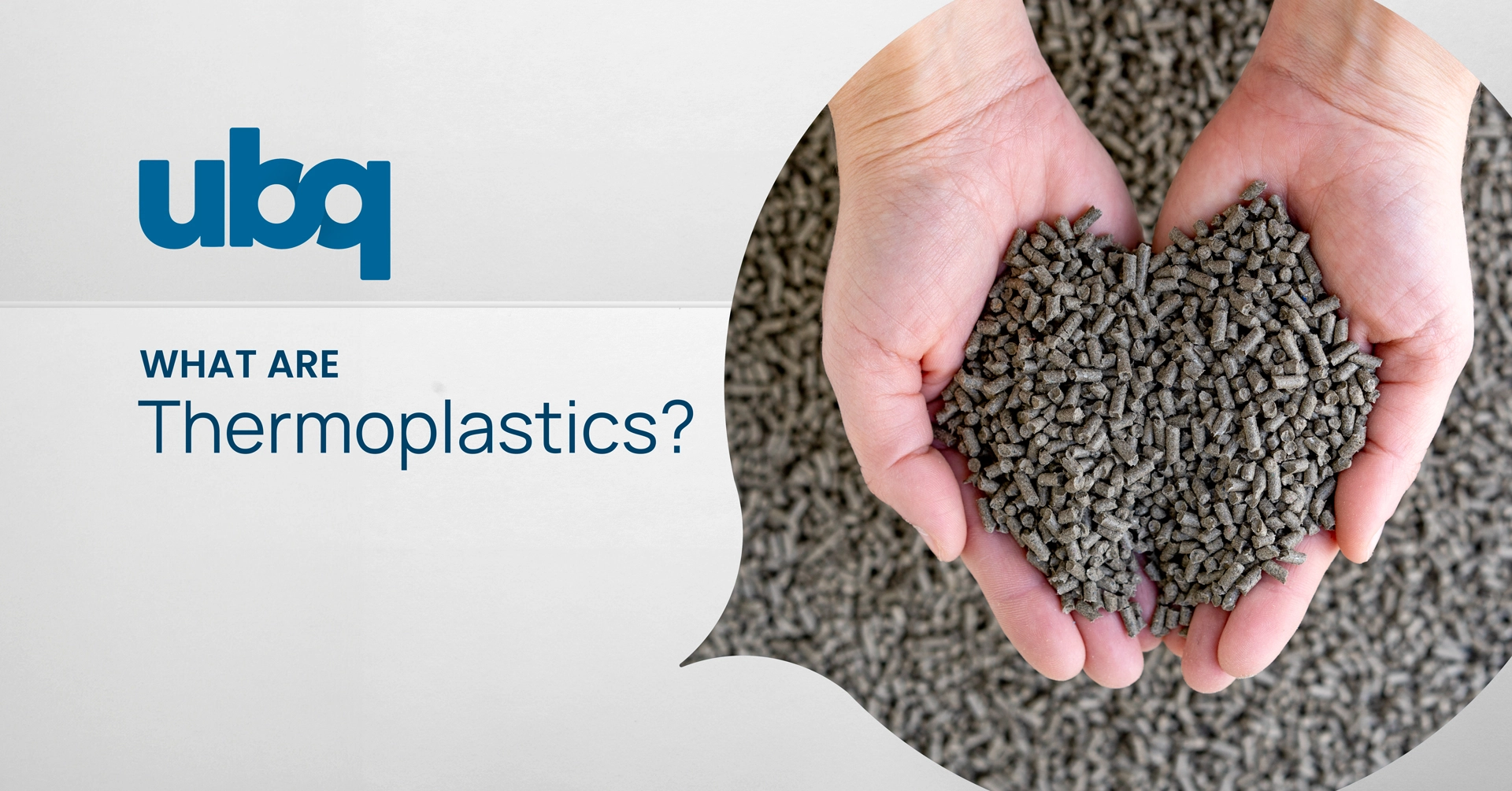
But not all thermoplastics are equal, and as sustainability moves to the center of manufacturing decisions, the question of what thermoplastics are made from, and how they are disposed of, has never mattered more. This guide covers everything you need to know: how thermoplastics work, the main types, their properties and applications, and how innovation is expanding what thermoplastics can be.
What is a Thermoplastic?
A thermoplastic is a type of polymer that softens when heated and solidifies again when cooled, a process that can be repeated multiple times without causing any change to the material’s chemical structure. This reversibility is what distinguishes thermoplastics from thermosets, and it is also what makes them so useful: a thermoplastic can be melted, molded into shape, cooled, and then remelted and remolded again.
The term comes from the Greek ‘thermos’ (heat) and ‘plastikos’ (able to be molded). In practical terms, thermoplastics are processed by heating the material until it becomes fluid or pliable, forming it into the required shape (through injection molding, extrusion, thermoforming or blow molding) and then allowing it to cool and harden.
Unlike thermosets, which undergo an irreversible chemical reaction during curing, thermoplastics undergo only physical change. No new chemical bonds are formed during heating, which is why the process is fully reversible and why thermoplastics are generally recyclable.
Thermoplastic vs Thermoset: What is the Difference?
The two main categories of plastic are thermoplastics and thermosets (also called thermosetting plastics). Understanding the difference matters because it directly affects recyclability, processing methods, and end-of-life options.
Thermoplastics soften reversibly with heat, making them moldable and recyclable. Thermosets cure through an irreversible chemical reaction; once set, they cannot be remelted. This gives thermosets very high rigidity and heat resistance, which makes them useful in specific applications (such as epoxy resins and certain composite materials), but it also means they are significantly harder to recycle.
Thermoplastic vs Thermoset: at a glance
| Thermoplastic | Thermoset | |
| Can it be remelted? | Yes | No |
| Is it recyclable? | Yes | Generally, not |
| Curing process | Physical (heat/cool) | Chemical (irreversible) |
| Processing methods | Injection molding, extrusion, thermoforming | Casting, compression molding |
| Typical strength | Good | Very high (rigid) |
| Common examples | PE, PP, PVC, ABS, UBQ™ | Epoxy, bakelite, polyester resin |
| Sustainability | Recyclable; can be bio-based | Difficult to recycle |
Table: Key differences between thermoplastics and thermosets across processing, recyclability and common applications.
How Do Thermoplastics Work?
Thermoplastics are made up of long polymer chains that are held together by relatively weak intermolecular forces (van der Waals forces). When heat is applied, these forces weaken and the chains become free to move, causing the material to soften and flow. When the material cools, the chains lock back into place and it solidifies, returning to its solid state with the same physical properties as before.
This is the fundamental mechanism that makes thermoplastics so versatile. The same piece of material can be repeatedly heated and reformed. In industrial terms, this means offcuts, sprues and rejected parts can be reground and reprocessed, reducing waste in the manufacturing process. It also means that post-consumer thermoplastic products can, in principle, be collected, melted, and remolded into new products.
Thermoplastic processing methods
The most common methods for processing thermoplastics into finished products include:
- Injection molding: molten thermoplastic is injected into a mold under pressure and cooled to form complex, precise shapes. Used for everything from bottle caps to car parts.
- Extrusion: the material is pushed through a shaped die to produce continuous profiles such as pipes, films and sheet goods.
- Thermoforming: a thermoplastic sheet is heated until pliable and then formed over a mold, used widely for packaging trays and vehicle interior panels.
- Blow molding: used to produce hollow shapes such as bottles and containers.
- 3D printing (FDM): thermoplastic filament is extruded layer by layer to build three-dimensional objects. One of the fastest growing processing methods.
Types of Thermoplastics
Thermoplastic polymers are broadly divided into two structural categories based on the arrangement of their molecular chains: crystalline and amorphous.
Crystalline thermoplastics
Crystalline thermoplastics have a regular, ordered molecular structure. This gives them higher density, better chemical resistance, and a sharper melting point. Common examples include polyethylene (PE) and polypropylene (PP). These materials tend to be opaque or translucent rather than clear.
Amorphous thermoplastics
Amorphous thermoplastics have a random, disordered molecular structure. They tend to soften gradually over a range of temperatures rather than at a precise melting point and are often transparent or clear. Common examples include polystyrene (PS), polyvinyl chloride (PVC), and ABS (acrylonitrile butadiene styrene).
Common Types of Thermoplastics
The table below shows major thermoplastic types, their molecular structure, common grades and typical applications. UBQ™ is included as a bio-based thermoplastic composite derived from mixed household waste.
| Type | Structure | Common examples | Typical uses |
| Polyethylene (PE) | Crystalline | HDPE, LDPE | Packaging, bottles, pipes |
| Polypropylene (PP) | Crystalline | PP homopolymer | Automotive parts, textiles, containers |
| Polystyrene (PS) | Amorphous | EPS (expanded PS) | Insulation, packaging, disposables |
| Polyvinyl chloride (PVC) | Amorphous | Rigid and flexible PVC | Pipes, flooring, window frames |
| Acrylonitrile butadiene styrene (ABS) | Amorphous | Acrylonitrile butadiene styrene | 3D printing, electronics, automotive |
| Thermoplastic polyurethane (TPU) | Semi-crystalline | TPU grades | Footwear, seals, cables |
| UBQ™ | Bio-based thermoplastic composite | UBQ™ thermoplastic grades: UBQ ClimaPos™ & UBQ Industrial | Industrial applications, construction, tertiary packaging components |
Properties and Benefits of Thermoplastics
The combination of properties that thermoplastics offer is what has made them so dominant across manufacturing industries. The most important are:
Recyclability
Because the changes thermoplastics undergo during processing are physical rather than chemical, they can be melted down and reprocessed multiple times without losing their fundamental material properties. This makes them significantly more sustainable than thermosets, which cannot be recycled in the same way. The recyclability of thermoplastics is central to circular economy strategies in manufacturing, though it depends on design, collection, and market demand.
Chemical resistance
Most thermoplastics are highly resistant to chemicals, including exposure to acids, alkalis and many solvents. This makes them well-suited to industrial process applications, fluid transport, and environments where contact with aggressive chemicals is likely. Thermoplastics also perform well as electrical insulators.
Thermal stability and dimensional stability
Thermoplastics maintain their shape and structural integrity across a wide range of temperatures, making them suitable for applications that involve both hot and cold fluid transport. Different thermoplastic grades are formulated for different temperature envelopes, from cryogenic pipework to high-temperature engineering applications.
Resistance to corrosion
Unlike metals, thermoplastics do not corrode. They perform well in corrosive environments, making them a preferred material for chemical storage, pipework, and marine applications where corrosion resistance is a priority.
Lightweight and strong
Thermoplastics offer high strength-to-weight ratios compared to metals and other traditional materials. This is particularly valuable in automotive and aerospace applications, where reducing weight directly reduces fuel consumption and emissions.
Low cost and ease of processing
Thermoplastics are generally cost-effective to produce and process at scale. High-volume injection molding, for example, can produce complex parts at very low per-unit cost. Combined with their recyclability, this makes thermoplastics the practical default for most mass-manufactured plastic products.
Thermoplastic Composites
Thermoplastic composites are materials in which a thermoplastic polymer forms the matrix (the binding material), reinforced by fibers, fillers, or other materials. The thermoplastic matrix gives the composite the same reversible processing behavior as a standard thermoplastic, while the reinforcement improves mechanical properties such as stiffness, strength, and impact resistance.
Common reinforcements in thermoplastic composites include glass fibers, carbon fibers, and natural fibers. Thermoplastic composites are increasingly used in automotive,aerospace,e and construction applications where weight reduction and recyclability are priorities. Unlike thermoset composites, thermoplastic composites can theoretically be reprocessed at their end of life.
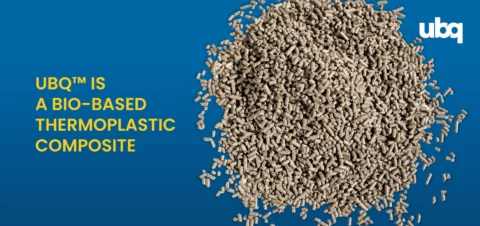
UBQ™ is a thermoplastic composite: a bio-based thermoplastic matrix derived from mixed household waste, including organic material and hard to recycle plastics. It functions as a drop-in additive or partial replacement material that can be processed using standard thermoplastic processing equipment.
Thermoplastics are used across virtually every manufacturing sector. The full range of thermoplastic applications spans packaging through to heavy industry. Common applications include:
Packaging
Thermoplastics dominate packaging. Polyethylene terephthalate (PET) is used for drinks bottles; high-density polyethylene (HDPE) for detergent and food containers; PP for yoghurt pots and ready-meal trays; and polystyrene for protective packaging. The recyclability of thermoplastics is a key factor in packaging sustainability strategies.
Automotive and Mobility
Dashboards, bumpers, interior panels, door trims and under bonnet components are all commonly made from thermoplastics including PP, ABS and polycarbonate (PC). The automotive industry uses thermoplastics to reduce vehicle weight while meeting safety and durability requirements. Manufacturers looking to reduce material emissions while maintaining performance can explore UBQ’s automotive and mobility applications.
Building and Construction
PVC is widely used for pipes, window frames and flooring. Thermoplastic pipework is used for water distribution, drainage, and gas supply. Thermoplastic sheets and profiles are used in roofing, cladding, and structural applications. For manufacturers seeking to develop lower-carbon building products without sacrificing performance or compliance, see UBQ’s building and construction applications.
Consumer Durables
Thermoplastics are the material of choice for household appliances, tools, furniture and long-life consumer goods, offering the combination of durability, design freedom and low processing cost that the consumer goods sector demand. UBQ’s consumer durables applications show how sustainable thermoplastics can be integrated without compromising cost or reliability.
Retail
Thermoplastics are widely used in retail environments: display fixtures, merchandising units, storage and point-of-sale components. As pressure grows to reduce the carbon footprint of private-label products and in-store environments, thermoplastic material choices are becoming a strategic sustainability lever. See UBQ’s retail applications.
Logistics and Supply Chain
Reusable pallets, crates, and bins are among the highest-volume thermoplastic applications in industrial logistics. The closed-loop nature of these systems makes material resilience and end-of-life recyclability particularly important. UBQ’s logistics and supply chain applications are purpose-built for exactly these demands.
Electrical and Electronics
Thermoplastics are the standard material for cable insulation, connectors, housings, and switches. Their electrical insulation properties, combined with ease of processing, make them the default choice for consumer electronics and industrial electrical components.
Medical and Healthcare
Medical-grade thermoplastics are used in devices, equipment housings, packaging and disposables. Their ability to be sterilized and their consistent material properties make them suitable for regulated applications.
3D Printing and Rapid Prototyping
FDM 3D printing uses thermoplastic filaments, most commonly polyactic acid (PLA), ABS and polyethylene terephthalate Glycol-modified (PETG). As 3D printing continues to expand into manufacturing and end-use part production, thermoplastics remain the dominant class of material.
The Future of Thermoplastics: Sustainability and Circular Manufacturing
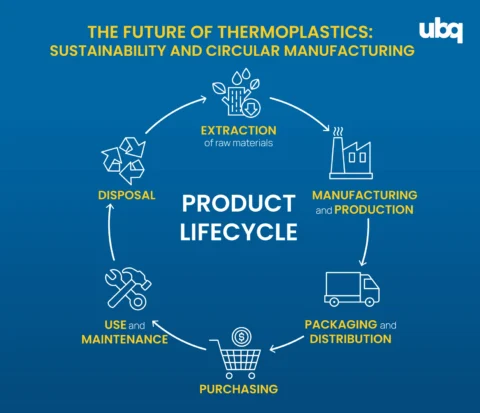
The environmental case for thermoplastics over thermosets is already strong: their recyclability makes them the logical choice for a circular economy. But the next frontier is not just recyclability; it is what thermoplastics are made from in the first place.
Conventional thermoplastics are derived from fossil fuels. The production of virgin plastic resins requires the extraction and processing of petroleum, generating significant carbon emissions and creating dependence on finite resources. As manufacturers face increasing pressure to reduce their carbon footprint and report against sustainability frameworks such as the UN Sustainable Development Goals (SDGs), the composition of thermoplastics, not just their recyclability, has become a strategic question.
Bio-based thermoplastics
Bio-based thermoplastics are derived from renewable biological feedstocks rather than petroleum. Examples include PLA, derived from corn starch or sugar cane, and various bio-based grades of PE and PP. Bio-based does not automatically mean biodegradable; many bio-based thermoplastics are chemically identical to their fossil-fuel-derived equivalents, with the same recyclability and mechanical properties.
Waste-derived thermoplastics: the UBQ™ approach
UBQ Materials has taken the concept of sustainable thermoplastics further by developing a material derived not from virgin biological feedstocks or fossil fuels, but from mixed household waste, including all organics, hard-to-recycle plastics, and other residual materials that would otherwise go to landfills or incineration.
Through UBQ Materials’ patented conversion process, this waste stream is converted into UBQ™, a bio-based thermoplastic composite that can be blended with conventional thermoplastic resins in standard processing equipment. Manufacturers integrating UBQ™ into their products benefit from a lower-carbon material that also diverts waste from landfills and incinerations, helping address both climate and waste impacts.
A verified third-party life cycle assessment (LCA) from ERM found that each kilogram of UBQ™ tablets temporarily removes 1.17 kilograms CO2eq per kilogram UBQ™ tablets, of biogenic carbon due to the conversion of organic waste into UBQ™, depending on the product’s end-of-life scenario, with a Fossil and land-use-related global warming potential (GWP) of only 0.15 kilograms of CO2eq per kilogram UBQ™ tablets. This results in a net cradle-to-gate carbon footprint of -1.02 kilograms CO2eq per kilogram UBQ™ tablets.
Because UBQ™ retains the recyclability properties of the thermoplastic matrix it is blended into, it does not compromise the end-of-life recyclability of finished products.
For manufacturers seeking to advance their SDG commitments or meet supply chain sustainability targets, UBQ™ offers a practical route to doing so without changes to processing infrastructure or finished-product performance.
Frequently Asked Questions about Thermoplastics
What is a thermoplastic?
A thermoplastic is a type of polymer that softens when heated and re-solidifies when cooled, without any change to its chemical structure. This means thermoplastics can be melted and remolded multiple times, making them recyclable and highly versatile for manufacturing.
What is the difference between a thermoplastic and a thermoset?
Thermoplastics soften reversibly when heated and can be reprocessed and recycled. Thermosets undergo an irreversible chemical reaction during curing and cannot be remelted once set. Thermosets typically offer greater rigidity and heat resistance, but their inability to be recycled is a significant environmental disadvantage.
What are some examples of thermoplastics?
Common examples of thermoplastics include polyethylene (PE), polypropylene (PP), polystyrene (PS), polyvinyl chloride (PVC), acrylonitrile butadiene styrene (ABS), and thermoplastic polyurethane (TPU). UBQ™ is a bio-based thermoplastic composite made from mixed household waste.
Are thermoplastics recyclable?
Yes. Because thermoplastics undergo only physical changes when heated, they can be melted down and reprocessed without losing their essential material properties. This makes them the most recyclable category of plastic and a core component of circular economy strategies in manufacturing.
What are thermoplastics used for?
Thermoplastics are used across packaging, automotive, construction, electronics, medical devices, consumer goods and 3D printing. Their combination of recyclability, chemical resistance, low weight and ease of processing makes them the default material for most mass-manufactured plastic products.
What are the main types of thermoplastics?
Thermoplastics are divided into crystalline (e.g. PE, PP, with ordered molecular structures and sharper melting points) and amorphous (e.g. PVC, PS, ABS, with disordered structures and gradual softening). Thermoplastic biobased composites, such as UBQ™, combine a thermoplastic matrix with reinforcing or functional additives.
Are thermoplastics sustainable?
Thermoplastics are more sustainable than thermosets because they can be recycled. Their environmental impact depends on what they are made from, the production process, and how they are managed at end of life. Bio-based and waste-derived thermoplastics, such as UBQ™, which is made from mixed household waste, significantly reduce the carbon footprint of thermoplastic products compared to virgin and recycled, fossil-fuel-derived resins.
Making Thermoplastics More Sustainable with UBQ™
UBQ™ is a bio-based thermoplastic material made from mixed household waste, including organics and hard to recycleplastics. It is compatible with standard thermoplastic processing equipment and can be blended with conventional resins to reduce the carbon footprint of finished products without compromising performance.
Manufacturers integrating UBQ can reduce their reliance on virgin or recycled fossil-fuel-derived plastics, divert waste from landfill incinerations and demonstrate meaningful progress against sustainability targets, all within existing production infrastructure.