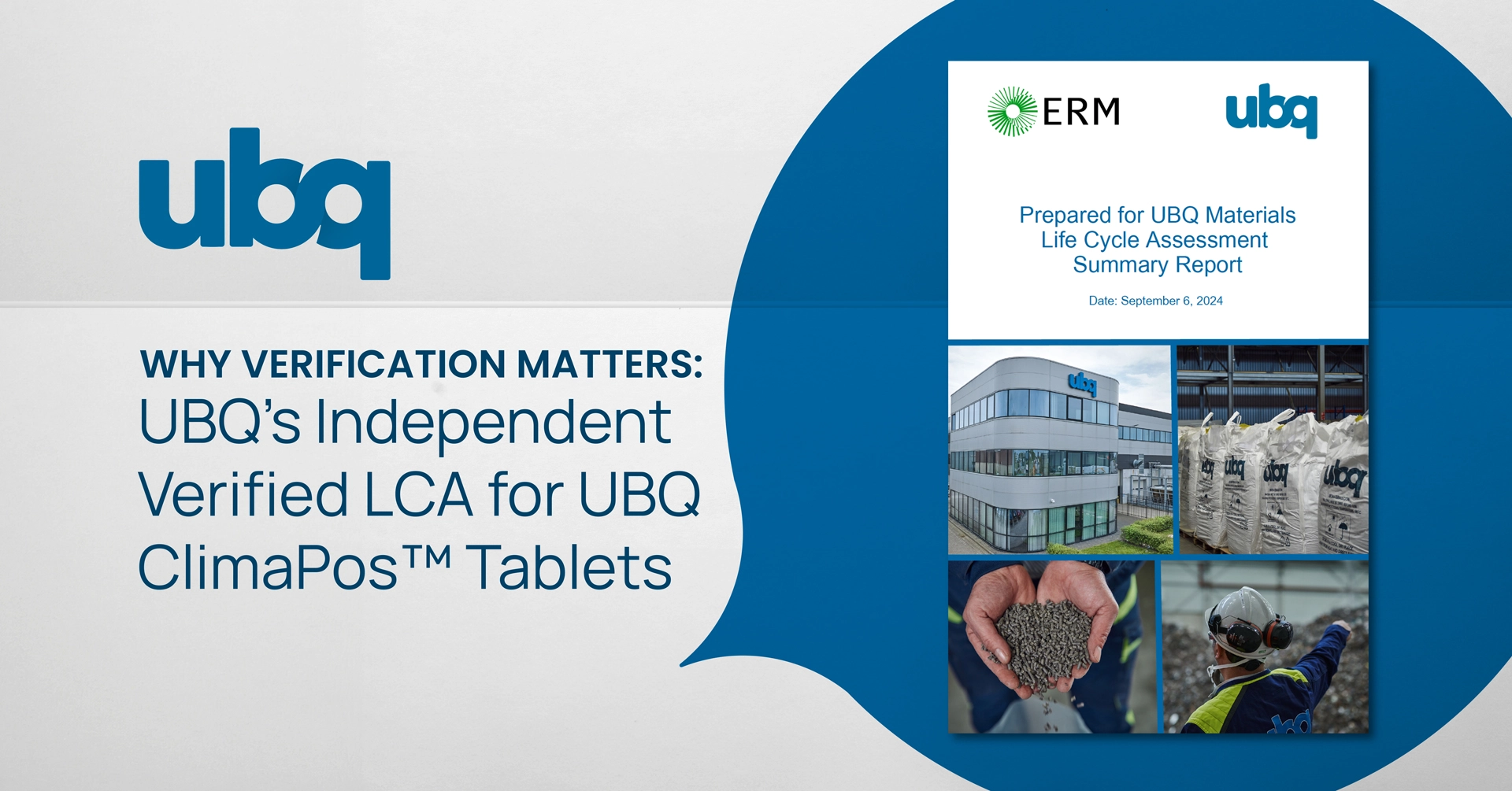
When a company wants to make a sustainability claim, credibility is vital. To ensure our environmental claims are valid and robust, and meet the highest standards of credibility and verification, it’s important to rely on respected partners and trusted methodologies.
This scientific rigor guides our assessment of environmental performance. UBQ Materials collaborated with ERM, a globally recognized sustainability consultancy, to conduct a comprehensive life cycle assessment (LCA) of UBQ ClimaPos™ Tablets produced at our production plant in Bergen op Zoom, The Netherlands. UBQ ClimaPos™ replaces finite, fossil-based resources and is made from mixed household waste, which is converted into a valuable material through a patented, energy-efficient process.
Founded in 1971, ERM is the world’s largest sustainability advisory firm trusted globally for its environmental expertise and industry benchmarks.
UBQ’s LCA Methodology
LCAs aim to provide a holistic picture of the environmental impacts of a product. LCA is a standardized method for quantifying environmental impacts across a product’s value chain, covering issues ranging from climate change to air pollution to ocean acidification. These assessments follow internationally recognized standards.
However, methodologies and scopes can vary; a cradle-to-gate LCA evaluates environmental impacts from raw material sourcing (upstream) through the manufacturing process, while a cradle-to-grave LCA extends further, including distribution to customers, use of the product, and end-of-life (EOL) management. UBQ’s LCA applies a cradle-to-gate scope, focusing on the material’s production impacts. Since the material can be integrated into countless applications, from building materials to automotive parts, the downstream impacts can vary widely depending on the final product. This approach ensures the assessment reflects the material’s production impact while leaving room for product-specific evaluations by our partners.
UBQ’s LCA was conducted in line with industry standards, including ISO 14040/44 and ISO 14025, and verified by an independent third party through a critical review. The methodology aligns with the product category rules for “plastic in primary forms” (PCR 2010:16), which also serve as the basis for environmental product declarations (EPDs), our next step in transparent reporting. The current LCA is based on design data, a standard step for new facilities.
UBQ’s LCA Results and Interpretation
Climate Change and GWP
ERM’s analysis found that the environmental impacts of producing UBQ ClimaPos™ Tablets are significantly lower compared to conventional plastics, particularly in terms of their carbon footprint.
Among the various impact categories assessed, the carbon footprint, measured as Global Warming Potential (GWP), is often the first that comes to mind. The concept of climate change is one of the most widely recognized environmental challenges, and its effects are becoming increasingly tangible in our daily lives with every year that passes.
GWP is expressed in terms of kilograms of carbon dioxide equivalent (kg CO2eq), which allows for comparison of the relative climate change impacts of different greenhouse gases (GHGs) such as carbon dioxide (CO2), methane, and nitrous oxide. Methane, for example, is shorter-lived in the atmosphere than CO2, but is much more effective at trapping heat during its lifetime. These differences are standardized through the GWP metric.
In UBQ’s LCA, GWP is reported using four categories:
- GWP-Fossil: Emissions associated with fossil fuel use in the production process and upstream supply chain.
- GWP-Biogenic: Emissions and removals of biogenic carbon, which originates from organic material that was sequestered through processes such as photosynthesis.
- GWP-Land Use and Land Use Change (LULUC): Carbon emissions and removals resulting from land use activities, such as deforestation and agriculture.
- GWP-Total: The aggregate of the three metrics above.
The carbon footprint of UBQ ClimaPos™ Tablets’ upstream sourcing and core production, measured as GWP-Fossil + GWP-LULUC, is 0.15 kg CO2eq per kg of UBQ ClimaPos™. Compared to conventional plastics, this is extremely low. To illustrate this, UBQ ClimaPos™ Tablets deliver a carbon footprint roughly between 1/15 and 1/20 of conventional plastics like PP, PE, or PS.
See, for example, the comparative table below, showing the results of UBQ’s LCA alongside European values for virgin polymers taken from ecoinvent 3. (UBQ’s full results are explained further down the post.)
| Material | GWP – Fossil | GWP – Biogenic | GWP – LULUC | GWP – Total |
| (kg CO₂eq/kg) | ||||
| Polypropylene (PP) | 2.36 | 0.01 | 0.001 | 2.37 |
| Polyvinyl chloride (PVC) | 2.13 | 0.02 | 0.002 | 2.16 |
| High-density polyethylene (HDPE) | 2.41 | 0.01 | 0.001 | 2.43 |
| High-impact polystyrene (HIPS) | 3.62 | 0.03 | 0.000 | 3.65 |
| UBQ ClimaPos™ Tablets | 0.15 | -1.17 | 0.001 | -1.02 |
Why the Footprint Is So Low
This exceptionally low footprint is the result of several key design decisions:
- Using mixed household waste as a resource rather than virgin materials, reducing or eliminating upstream extraction, transportation, and energy-intensive processing.
- Operating a low-energy production process (below 200°C), with no combustion, pyrolysis, or direct process emissions.
- Powering operations with 100% renewable electricity, certified through Guarantees of Origin (GOO).
The first element especially sets UBQ ClimaPos™ Tablets far apart. While other manufacturers can (and should) find ways to increase energy efficiency and use renewable energy sources, it is far more difficult to achieve such a low upstream impact when relying on virgin raw materials.
Zero-Burden Modeling
This is where UBQ’s “zero-burden” modeling follows ISO guidance for secondary material inputs, makes a critical difference, and ensures comparability with other waste-derived systems. Under this methodology, any emissions occurring up until the waste reaches the waste handler belong to its original life cycle and are allocated to the product’s primary use.
For example, if a plastic tub containing remnants of potato salad is discarded and eventually is converted into UBQ ClimaPos™, the GHG emissions from growing the potatoes, producing the mayonnaise, and manufacturing the plastic tub are attributed to the first cycle, not to UBQ ClimaPos™ Tablets. UBQ carries the environmental impacts of the waste feedstock, beginning with the transportation of the household waste to UBQ’s facility and the sorting and drying preparation steps that precede the actual conversion process.
Biogenic Carbon Storage
UBQ ClimaPos™ Tablets offer an additional climate advantage; its feedstock of mixed household waste includes organic waste like food scraps, dirty paper and cardboard, and garden trimmings. UBQ ClimaPos™ Tablets temporarily store biogenic carbon for the material’s lifespan. This benefit depends on EOL scenarios, which remain an active topic of discussion across the LCA community.
Each kg of UBQ ClimaPos™ Tablets removes 1.17 kg CO2eq of biogenic carbon, which is reported as a negative emission on a cradle-to-gate basis. As a result, the net cradle-to-gate carbon footprint (GWP-Total) is -1.02 kg CO2eq per kg of UBQ ClimaPos™ Tablets, indicating a climate-positive material, with the potential to store more carbon than is emitted during its production.
When cradle-to-grave system boundaries are considered for products with stored biogenic carbon, it’s commonly assumed that this biogenic carbon is released at the product’s EOL either through incineration or degradation in landfills. Under this approach, all biogenic carbon is modeled as a positive emission at the end of the product’s life.
UBQ Materials is currently conducting studies to find out whether the biogenic carbon stored in UBQ ClimaPos™ Tablets does indeed decompose in landfill conditions, and, if it does not all decompose, whether the remaining carbon can be validated as long-term carbon removal.
UBQ Materials also prioritizes long-lived applications (like construction products) and closed-loop value chains to maximize the environmental benefit of its biogenic carbon storage. These ongoing assessments reflect UBQ’s commitment to evidence-based environmental claims and to continuous improvement in carbon accounting methodologies.
Beyond Carbon
As important as climate change is, a holistic LCA evaluates a wide range of environmental impacts beyond the carbon footprint, providing a more complete capture of the product’s impacts on the ecosystem. We’ll highlight a few of these key impact categories below. You can read more about our LCA results by completing the form: https://www.ubqmaterials.com/environmental-impact/.
Acidification Potential (AP)
Acidification measures the product’s contribution to the formation of acidic compounds like sulfur dioxide, which can lead to acid rain when they react with water in the atmosphere. Human activity is a significant source of these emissions through fossil fuel combustion and other industrial processes.
Acidification affects the food chain as well as human health. Increased acidity in rainwater can impact plant growth, and acidic emissions can contribute to respiratory issues in humans. Acidification also affects marine ecosystems; as the oceans become more acidic, it is harder for sea organisms like oysters, corals, and snails to build shells, which affects biodiversity and ecosystem health. Since the beginning of the Industrial Revolution, the oceans have become 30% more acidic, threatening marine biodiversity. By the end of this century, levels could reach acidity levels that haven’t been seen for 14 million years.
Acidification and other non-carbon impacts metrics are less familiar to the public than GWP and are often expressed in scientific units. AP is measured in moles of H+ equivalent per kg. For UBQ ClimaPos™ Tablets, the value is 7.92E-04 mol H+ eq per kg. To put this in context, UBQ’s acidification potential is significantly lower than that of comparable conventional materials it can replace, such as oil-based HDPE and certain bio-based plastics, supporting its role as a lower-impact alternative across multiple impact categories.
Eutrophication Potential (EP)
Eutrophication Potential refers to the over-enrichment of ecosystems with nutrients like phosphorus and nitrogen, which can lead to severe environmental impacts. Some of the key human activities contributing to this process are the use of fertilizers in agriculture, sewage discharge, stormwater runoff, and fossil fuel combustion.
These inputs introduce high levels of nutrients into water bodies, disrupting natural nutrient cycles. In coastal waters, excess nutrients promote rapid growth of organisms like phytoplankton, microalgae, and seaweed, leading them to explode in population and crowd out other species. Harmful algal blooms can kill large numbers of fish and birds. When the excess organisms spurred on by eutrophication die and sink to the bottom, they can disrupt the ecosystem to such an extent that the lower depths of the water are left without oxygen and cannot support life.
EP is measured separately in freshwater, marine, and terrestrial environments using different metrics. For example, the marine EP result for UBQ ClimaPos™ Tablets is 3.98E-04 kg N eq per kg. This indicates a relatively low contribution to nutrient enrichment in marine environments compared to many conventional plastics, although detailed comparisons remain application-specific.
Ozone Depletion Potential (ODP)
Ozone Depletion Potential measures the deterioration of ozone in the stratosphere caused by substances like chlorofluorocarbons (CFCs), which are produced by human activities, including refrigeration and air conditioning. You may remember hearing about the hole in the ozone layer a few decades ago. Although the Montreal Protocol of 1987 successfully reversed much of the historical damage, ozone-depleting substances released before it took effect and emissions of nitrous oxide still contribute to periodic thinning.
The ozone layer functions as a vital protective shield, filtering harmful UVB radiation from reaching Earth’s surface. This radiation causes skin cancer and eye damage, so ODP has large implications for human health. It can also slow the growth of plants and small marine organisms, leading to disruptions in the food web. The ODP of UBQ ClimaPos™ Tablets is 2.81E-10 g CFC-11 eq per kg, indicating a very low contribution to ozone layer depletion relative to many historical ozone-depleting substances.
The Full Picture
One benefit of conducting an LCA is its ability to illuminate the full spectrum of environmental impacts associated with a material or product, which allows us to assess whether there are unforeseen tradeoffs to the benefits we’re trying to achieve. For example, does soy-based material reduce reliance on fossil fuels only to carry unintended consequences such as a high land use impact or elevated eutrophication potential?
With UBQ ClimaPos™ Tablets, this comprehensive approach is essential. Thanks to our independent, third-party-verified LCA, the results confirm that UBQ ClimaPos™ Tablets’ benefits are not gained at the expense of other environmental burdens. The results demonstrate that UBQ ClimaPos™ Tablets consistently deliver a strong performance across multiple impact categories, confirming its role as a low-impact, climate-beneficial material solution.
By quantifying our impacts transparently and independently, UBQ helps customers make informed, data-driven choices that support a circular and low-carbon economy.